
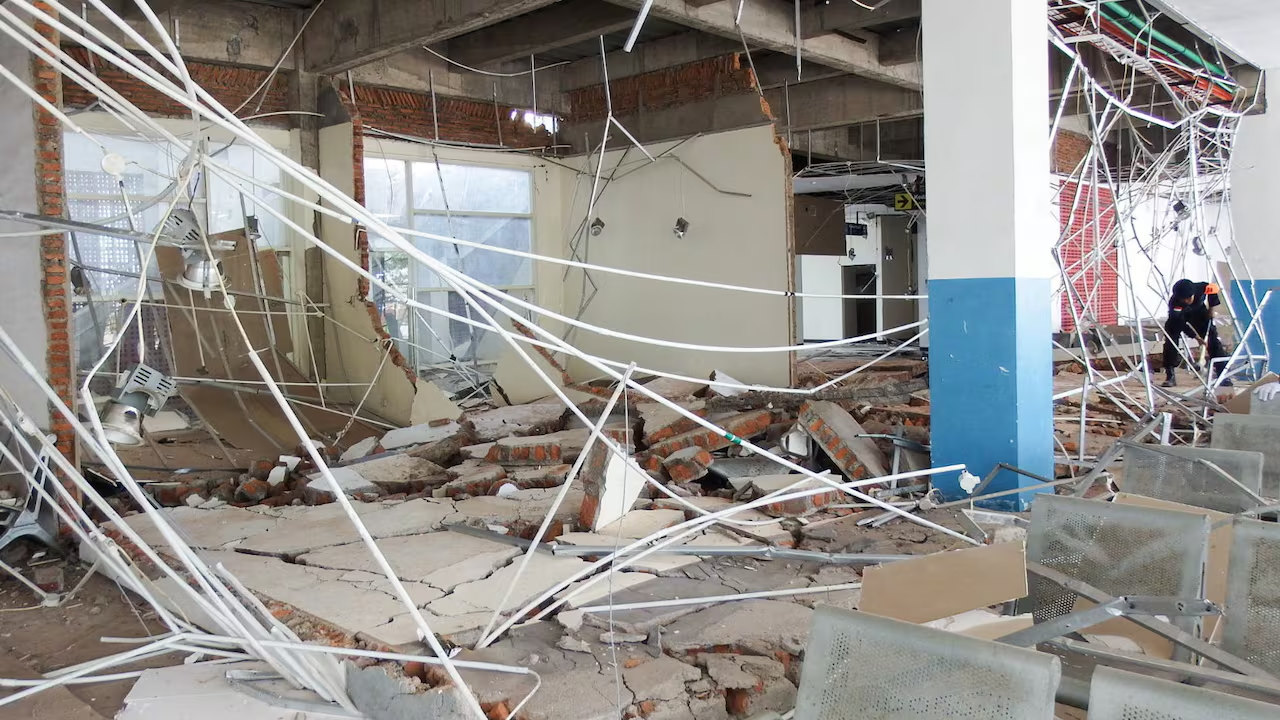
MAUMERE, Indonesia — A massive rescue operation is underway across eastern Indonesia after a powerful magnitude 7.7 earthquake struck the island of Flores, killing at least 51 people, injuring over a hundred others, and triggering an unfolding humanitarian crisis. Heavy machinery and emergency responders are racing against time to reach isolated mountainous villages, while a second, separate magnitude 6.9 earthquake struck thousands of kilometers away on Sumatra island, underscoring the constant peril faced by the archipelago.
The initial, highly destructive quake struck early Saturday morning just before 6:00 AM local time, with its epicenter located off the coast of Flores Island in East Nusa Tenggara province. The violent shaking lasted for nearly a minute, collapsing concrete buildings and sending terrified coastal residents fleeing to higher ground in a panicked rush to escape a temporary tsunami warning. According to Indonesia’s National Disaster Management Agency (BNPB), the death toll is concentrated heavily in the Manggarai, East Manggarai, and Sikka regencies, where victims were crushed inside their homes or buried beneath sudden landslides.
A Mountainous Island Cut in Two
The most significant bottleneck facing rescue crews is the severe physical destruction of regional transport networks. The Trans-Flores Highway, a vital 700-kilometer thoroughfare that links communities across the rugged, mountainous island, has been completely severed by massive landslides.
- Isolating the Vulnerable: Entire villages in the interior remain completely cut off from the outside world, preventing ambulances and heavy digging equipment from reaching flattened neighborhoods.
- Blackouts and Silence: Major power grid failures and the collapse of cellular communication towers have plunged large swaths of Flores into digital silence, severely hampering coordination efforts between disaster teams.
- Military Mobilization: More than 3,500 military and police personnel have been deployed to the disaster zones to clear debris by hand, establish field hospitals, and begin the complex process of tunneling through blocked roads.
The Night Under the Open Sky
The psychological toll on the population is mounting rapidly. The BNPB confirmed that the initial earthquake destroyed more than 900 homes and severely damaged 450 more, forcing roughly 5,000 residents into overcrowded, makeshift temporary shelters.
However, thousands of other residents whose homes survived the initial shock refuse to sleep indoors. Traumatized by more than 340 recorded aftershocks—including a powerful magnitude 6.2 tremor that rattled the island later in the day—families have pitched tarpaulins and green plastic tents in open fields, soccer stadiums, and public parks.
In tourism hubs like Labuan Bajo—the famous gateway to Komodo National Park—visitors and hotel staff evacuated into streets and squares. Local farmers describe an intense, violent shaking that left their properties unstable and their families too terrified to return to their beds.
A Broken Infrastructure and a Second Shock
Beyond residential spaces, the earthquake has taken a heavy toll on the island’s social infrastructure, damaging at least 167 public facilities, including schools, health clinics, and churches. Relief workers have initiated emergency airlifts to distribute rice, ready-to-eat meals, clean drinking water, and medical supplies. However, local officials warn that the capacity of regional trauma wards is completely stretched, forcing doctors to treat fractured bones and head wounds under open-air medical tents.
As emergency personnel on Flores battle landslides, the tectonic volatility of the region was spotlighted hours later when the magnitude 6.9 quake struck Northern Sumatra. While that second event caused no immediate casualties due to its extreme depth, its timing serves as a grim warning. Ground teams on Flores face an increasingly complex race against the clock to recover those still missing beneath the rubble before impending structural failures cause further collapse.