
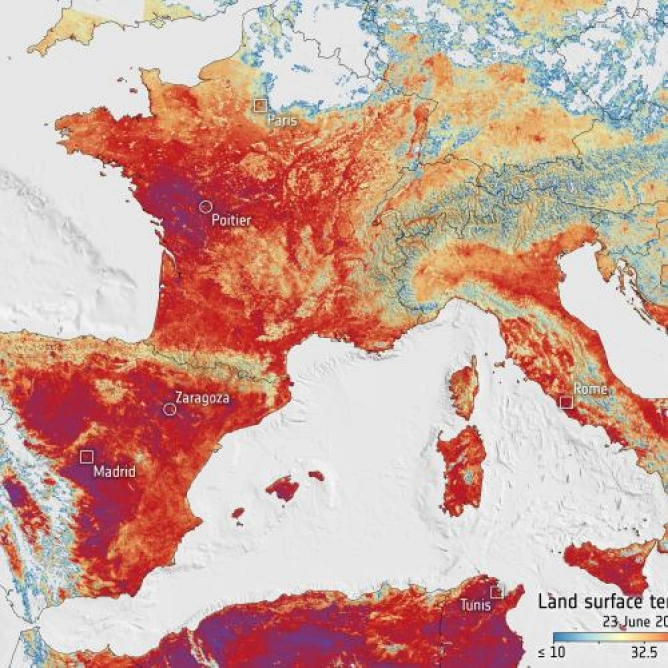
BERLIN — An unprecedented, climate-driven heatwave has rewritten the meteorological history books of Central Europe and Scandinavia, pushing temperatures to dangerous new heights and plunging infrastructure into a state of emergency. As an estimated 150 million people across the continent cope with temperatures exceeding 35 degrees Celsius, national weather agencies confirmed that all-time temperature records fell consecutively in Germany, Denmark, and the Czech Republic.
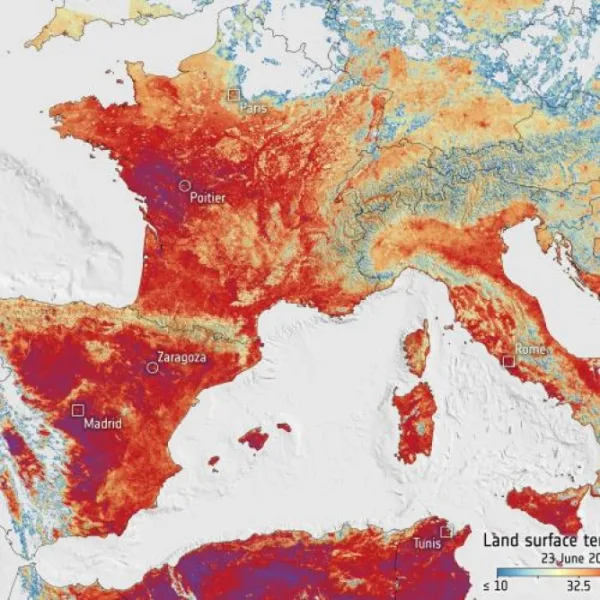
The extreme weather event, which originated in the Iberian peninsula, has slowly migrated north and east, leaving a trail of heat-related fatalities and buckling highways in its wake. Climate scientists from the World Weather Attribution group issued a stark warning, declaring the system the most severe heatwave ever recorded in the region—an anomaly that would have been virtually impossible just decades ago without human-driven global warming.
Germany Sizzles Under Consecutive Record Highs
For the second day in a row, Germany shattered its national all-time temperature record. The German Weather Service announced a provisional reading of 41.5 degrees Celsius in the eastern community of Möckern-Drewitz, in Saxony-Anhalt. This surpassed the previous record of 41.3 degrees Celsius, which had been set just 24 hours prior in the southwestern city of Saarbrücken.
The historic heat has pushed the nation’s critical transport network to its limits. On the crucial A2 motorway near Berlin, intense, prolonged thermal expansion caused older concrete sections of the highway to expand, buckle, and break apart, forcing authorities to enact emergency full closures. National rail operator Deutsche Bahn urged passengers to postpone all nonessential travel as steel tracks faced deforming risks.
In urban centers like Berlin, police deployed water cannons to spray a cooling mist over wilting crowds in public squares. Meanwhile, emergency services faced a surge in rescue calls, prompting the evacuation of dozens of elderly residents from a nursing home in Dormagen due to failing indoor cooling conditions.
Unprecedented Meltdown in Scandinavia and the Czech Republic
The extraordinary high-pressure system has brought tropical conditions to Nordic countries entirely unaccustomed to sweltering summers. The Danish Meteorological Institute reported a historic high of 37 degrees Celsius in Ødum, located north of Aarhus. The temperature marked Denmark’s warmest day since comprehensive record-keeping began in 1874, breaking a benchmark that had stood for over a century.
Simultaneously, the Czech Republic experienced its hottest day on record. The Czech Hydrometeorological Institute confirmed that a weather station in Doksany, north of Prague, reached a blistering 40.6 degrees Celsius, eclipsing the country’s previous historical high of 40.4 degrees Celsius from 2012.
The extreme heat paralyzed daily life in Prague, leaving city streets unusually deserted as residents sought refuge indoors or at local swimming pools. The capital’s public transport operator ordered tram speeds slowed drastically to avoid the imminent risk of overhead power wires warping and snapping in the ambient heat. Specialized water trucks cruised the asphalt streets, spraying water to artificially cool the pavement and combat rising ground-level ozone concentrations.
A Dangerous New Normal for Europe
Public health officials are voicing growing concern over tropical nighttime conditions, where temperatures have failed to drop below 22 degrees Celsius across much of Central Europe. This lack of nocturnal cooling deprives the human body of its natural ability to recover from daytime heat stress, drastically multiplying the risk of heatstroke and excess mortality among vulnerable demographics.
The logistical strain is compounded by a structural reality: residential air conditioning is historically rare across Germany and northern Europe, leaving millions with no mechanical escape from the oppressive climate.
As weather services warn that temperatures could peak even higher as the system continues its trajectory into Poland and the Balkans, the weekend’s events have intensified the geopolitical debate over the climate crisis. For a continent grappling with buckling infrastructure and hundreds of heat-linked deaths, the shattered records are a clear indicator that the reality of a warming world has arrived at its doorstep.