
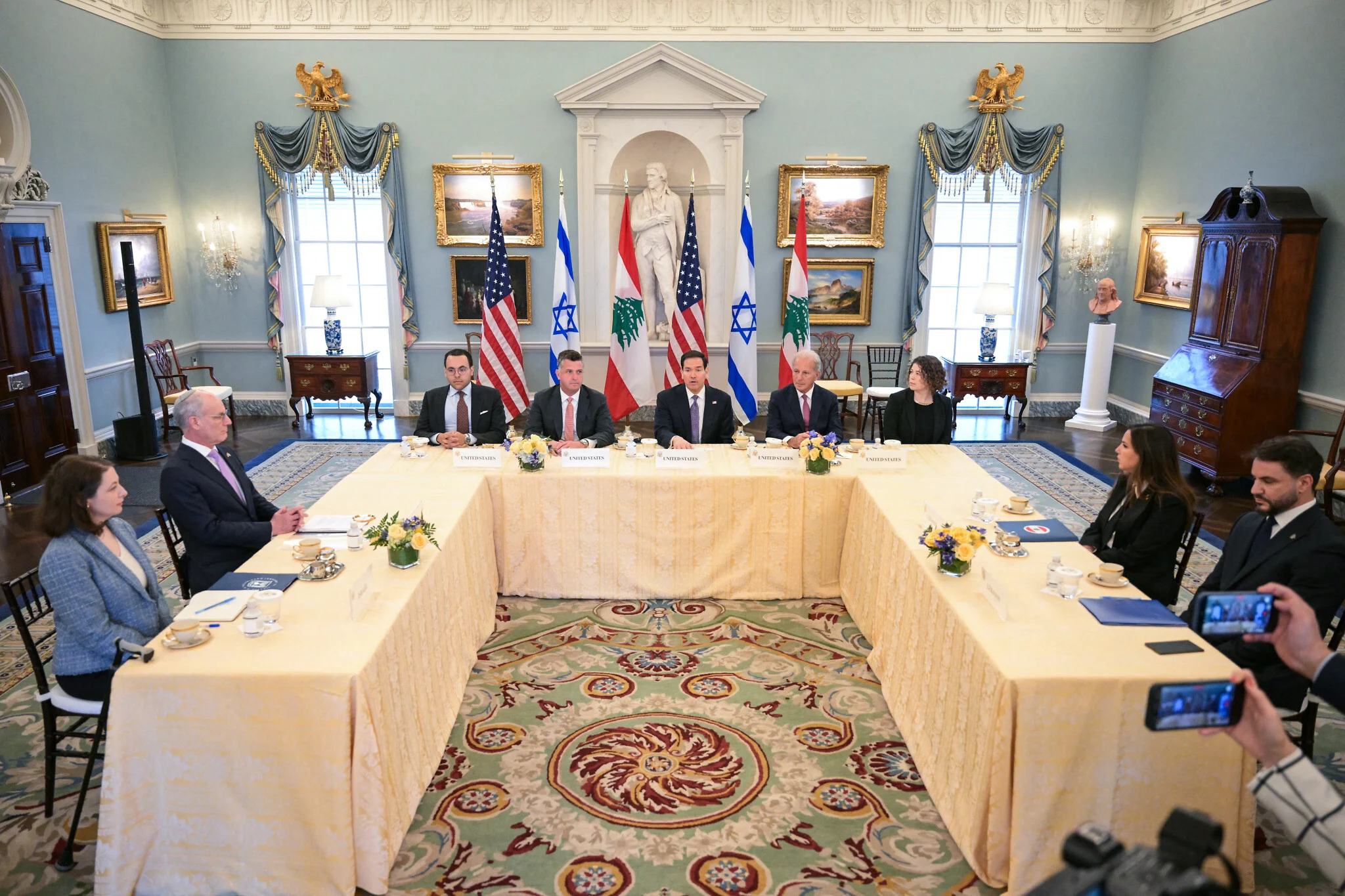
In a quiet conference room at the U.S. State Department on Tuesday, the long-standing “Gate of Tears” between Israel and Lebanon finally yielded to the weight of diplomacy. For the first time since the 1993 Madrid-era negotiations, representatives from the two neighboring nations—technically at war for 78 years—sat face-to-face for direct, in-person talks.
Hosted by Secretary of State Marco Rubio and U.S. Ambassador to the UN Mike Waltz, the summit brings together Israeli Ambassador Yechiel Leiter and Lebanese Ambassador Nada Hamadeh Moawad. The meeting is being hailed by the White House as a “historic opportunity” to decouple the sovereign state of Lebanon from the regional fires stoked by Hezbollah and its patrons in Tehran.
A New Voice in Beirut
The catalyst for this diplomatic shift is the emergence of a more assertive Lebanese presidency. President Joseph Aoun, who rose to power on a platform of restoring state sovereignty, has been vocal about the need for a direct channel.
“Diplomatic solutions have consistently proven to be the most effective means of resolving armed conflicts,” Aoun stated ahead of the talks. His administration has taken the unprecedented step of criminalizing non-state military activities, a direct shot across the bow of Hezbollah, which has faced significant military setbacks during the recent Israeli ground invasion of southern Lebanon.
For Israel, the goal is “normalization” rather than just a ceasefire. “We have no interest in your land,” Ambassador Leiter told his Lebanese counterparts, “only in our collective security.”
The Elephant Not at the Table
While the atmosphere in Washington was described as “serious and professional,” the reality on the ground remains jagged. Hezbollah, which was not represented in the talks, has dismissed the summit as “futile.”
As the ambassadors sat down in D.C., the northern border of Israel was hit by a barrage of 24 rockets, a reminder that the Lebanese government’s authority over its southern provinces remains aspirational. Hezbollah leader Naim Qassem has vowed that the group will not abide by any agreement reached in Washington, branding the Lebanese negotiators as “instruments of a foreign agenda.”
The Roadblocks to a Final Deal
Despite the symbolic power of the meeting, Secretary Rubio warned that these talks are a “process, not an event.” Several high-stakes hurdles remain:
- The Disarmament Mandate: Israel is insisting on the full implementation of a demilitarized zone south of the Litani River, overseen by the Lebanese Armed Forces (LAF) rather than UNIFIL.
- The “Iran Blockade”: The talks are occurring against the backdrop of a U.S. naval blockade in the Strait of Hormuz. Lebanon’s Prime Minister, Nawaf Salam, has rejected Iranian offers to negotiate on Beirut’s behalf, insisting that Lebanon will represent its own interests for the first time in decades.
- The Return of the Displaced: Over a million Lebanese citizens and 100,000 Israelis remain displaced from their homes. Israel has stated that no returns will be permitted until a “permanent security framework” is signed.
A Fragile Hope
For a region that has spent three decades communicating through mediators, the mere sight of Israeli and Lebanese officials in the same room is a tectonic shift. It signals a growing appetite within Beirut to reclaim its political future from the “proxy war” cycle that has hollowed out the nation’s economy.
“We are working against decades of history and complexities,” Rubio admitted. But as the delegates prepare for a second day of deliberations, the world is watching to see if 2026 will be the year the “Blue Line” finally becomes a border of peace rather than a front of war.