
ABOARD THE ORION SPACECRAFT / HOUSTON — For the first time in fifty-four years, human eyes have looked upon the “Dark Side” of the Moon.
Late Sunday evening, as the Orion capsule Integrity crossed into the lunar sphere of influence, the four-person crew of the Artemis II mission caught their first direct glimpse of the moon’s rugged far side. It is a view that hasn’t been witnessed by a living soul since the departure of Apollo 17 in 1972—and for this crew, the moment was nothing short of transformative.
“We just cleared the limb, and there it is,” Mission Specialist Christina Koch radioed to Mission Control in Houston, her voice crackling with a mix of professional focus and raw wonder. “It’s not the smooth, ‘Man in the Moon’ face we see from home. It’s an absolute wilderness of craters. It looks like a battlefield of the solar system.”
A Record-Breaking Orbit
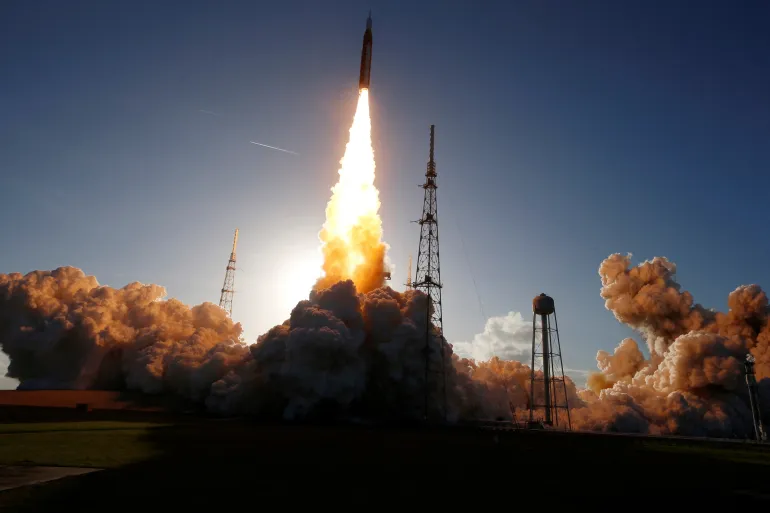
The milestone comes on Flight Day 5 of a mission that has, so far, been a masterclass in modern aerospace engineering. After a flawless launch from Kennedy Space Center on April 1, the crew—Commander Reid Wiseman, Pilot Victor Glover, and Mission Specialists Christina Koch and Jeremy Hansen—have traveled over 230,000 miles to reach this point.
The spacecraft is currently following a “free-return” trajectory, a cosmic slingshot that will take the crew approximately 4,700 miles beyond the lunar surface. At its furthest point, Orion will set a new record for the greatest distance from Earth ever traveled by a crewed vehicle, surpassing the legendary mark set by the crippled Apollo 13 mission in 1970.
Science Through Human Eyes
While robotic probes like the Lunar Reconnaissance Orbiter (LRO) have mapped every inch of the moon in high-resolution, NASA scientists emphasize that having humans on-site provides “contextual intelligence” that machines lack.
The crew is currently engaged in a seven-hour intensive observation period. Working in pairs to manage the limited window space of the Orion capsule, they are documenting specific geological features:
- The Orientale Basin: One of the most striking “bullseye” impact craters, which straddles the western limb of the Moon.
- The South Pole-Aitken Basin: A massive, dark depression that holds the secrets to the Moon’s earliest history and potential water ice.
- Shadow Relief: Because the sun is hitting the far side at a low angle, the long shadows are revealing ridges and slopes that usually appear flat in satellite imagery.
“Human eyes can pick out subtle color variations in the regolith and the way light plays off the crater rims in ways a sensor can’t always prioritize,” said a NASA flight director during an afternoon briefing. “This isn’t just a sightseeing tour; it’s the ultimate scouting mission for the Artemis III landing.”
The Silent 40 Minutes
The most harrowing part of the journey is yet to come. Tomorrow, April 6, as Orion loops directly behind the Moon, the crew will enter a “Loss of Signal” (LOS) period. For approximately 40 minutes, the bulk of the Moon will block all radio communication with Earth.
During this silence, the crew will be more isolated than any humans in history, alone with the stark, monochromatic landscape of the lunar far side. When they emerge on the other side, they will witness the legendary “Earthrise”—the sight of our blue-and-white home cresting over the gray lunar horizon.
The Road Home
Once the flyby is complete, the Moon’s gravity will naturally pivot Orion back toward Earth. The crew is scheduled to splash down in the Pacific Ocean off the coast of San Diego on April 11.
For now, however, the mission is about the view. As Commander Reid Wiseman noted shortly after the first far-side sighting: “We’ve spent our whole lives looking up at the Moon. It’s a very different feeling when the Moon is the only thing you can see out the window.”