
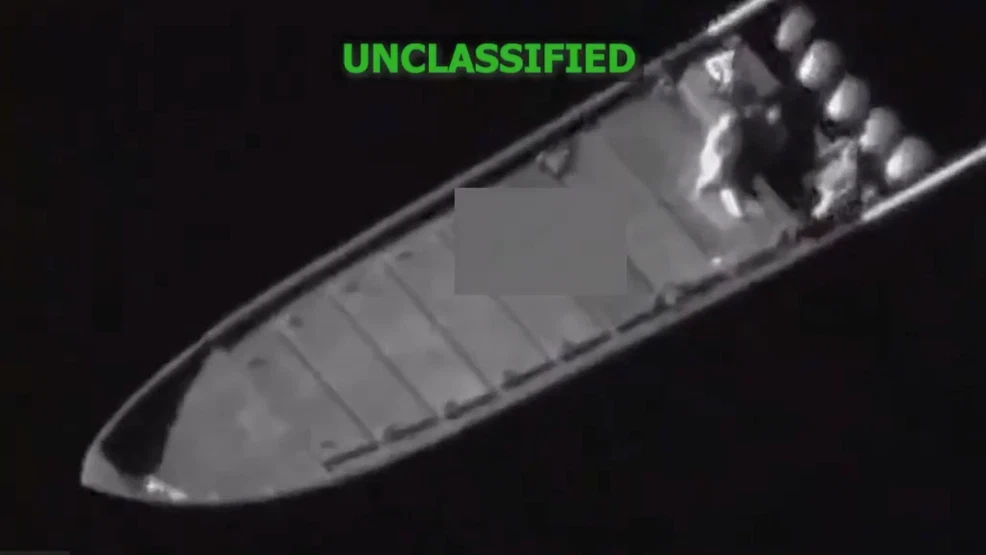
In one of the deadliest days of a monthslong maritime offensive, the U.S. military confirmed Tuesday it has carried out three separate kinetic strikes on alleged drug-smuggling vessels, killing 11 people in the eastern Pacific and Caribbean.
The strikes, conducted Monday, mark a sharp intensification of the Trump administration’s “Operation Southern Spear.” U.S. Southern Command (SOUTHCOM) released grainy, thermal footage of the operations on X, showing small, open-decked boats being engulfed by massive explosions. According to the Pentagon, “intelligence confirmed the vessels were transiting along known narco-trafficking routes” and were operated by “designated terrorist organizations.”
The latest fatalities bring the total death toll from the U.S. boat-strike campaign to at least 145 people since targeting began last September.
A Coordinated Triple Strike
The operations spanned two oceans and involved at least three separate targets:
- Eastern Pacific: Two vessels, each carrying four people, were struck and destroyed.
- Caribbean Sea: A third boat carrying three people was hit.
Defense Secretary Pete Hegseth praised the precision of the strikes, posting a provocative message on social media: “Turns out President’s Day—under President Trump—is not a good day to run drugs.”
Despite the high body count, the Pentagon provided no immediate physical evidence—such as seized narcotics or intercepted manifests—to prove the vessels were carrying drugs. Critics note that because the boats are often “annihilated” by the munitions used, verifying their cargo after a strike is nearly impossible.
War Rules on the High Seas
President Trump has repeatedly characterized the effort as an “armed conflict” with Latin American cartels, justifying the use of lethal force as a necessary escalation to stop the flow of fentanyl and cocaine.
However, the campaign continues to draw fierce fire from legal experts and human rights organizations, who argue that the strikes constitute extrajudicial killings.
- Lack of Due Process: Unlike traditional interdiction, where Coast Guard teams board vessels and arrest suspects, these strikes provide no opportunity for surrender.
- The Fentanyl Gap: Policy analysts at WOLA (Washington Office on Latin America) point out that while the military is sinking boats in the Pacific, the vast majority of fentanyl—the primary driver of the U.S. overdose crisis—enters through land ports of entry on the Mexican border.
Geopolitical Pivot: From Venezuela to the Middle East
The uptick in strikes comes at a strategic crossroads for the U.S. Navy. For months, the military focus remained squarely on the Western Hemisphere, a pressure campaign that culminated in the January capture of former Venezuelan leader Nicolás Maduro.
But that focus is shifting. Even as the “narco-strikes” continue, the USS Gerald R. Ford and its accompanying destroyers have reportedly crossed the Atlantic, heading toward the Middle East. The move follows recent threats from President Trump to target Iran if it fails to reach a new nuclear agreement.
With the heavy hitters of the Navy departing the region, the Pentagon appears to be relying more heavily on drone-led “kinetic strikes” to maintain its presence in Latin American waters. For the crews of these alleged “narco-boats,” the message from Washington is clear: the sea is no longer a sanctuary; it is a kill zone.