
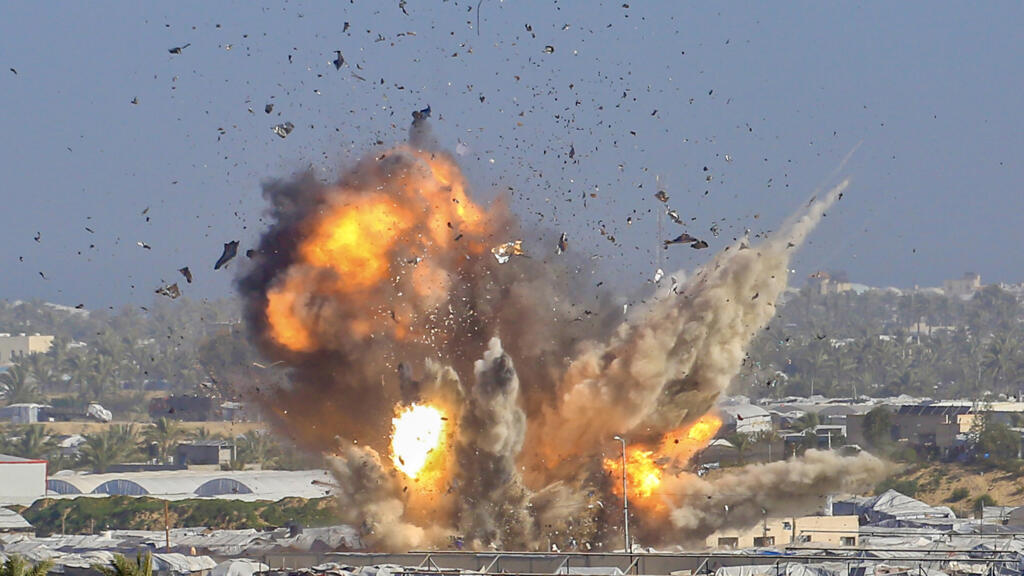
GAZA CITY — A wave of relentless Israeli air strikes tore through the Gaza Strip on Saturday, killing at least 32 Palestinians and leaving dozens more trapped beneath the smoldering ruins of residential blocks. The attacks, which rescue officials described as some of the most concentrated in weeks, hit hardest in the central and northern districts, areas where thousands of displaced families had sought refuge.
The Palestinian Civil Defense reported that the majority of the casualties occurred in the Nuseirat refugee camp and Gaza City’s Sabra neighborhood, where missiles leveled several multi-story homes without warning.
“It was a circle of hell,” said Mahmoud Basal, a spokesperson for the Civil Defense. “We are digging with our bare hands. There is no fuel for the bulldozers, and the drones are still circling above. Most of the martyrs we are pulling out are women and children.”
Midnight in Nuseirat
The deadliest single strike occurred shortly after midnight in the Nuseirat camp. According to medics at the Al-Aqsa Martyrs Hospital, a single missile struck a crowded housing complex, killing 12 members of the same family.
Survivors described a scene of total disorientation. “The walls simply vanished,” said Ahmed al-Danaf, who escaped the blast. “We were sleeping, and then we were breathing dust and blood. My children were screaming in the dark, and we couldn’t find the door because the house wasn’t a house anymore.”
The Casualty Breakdown (Saturday):
- Nuseirat Camp: 17 killed, including 5 children.
- Gaza City (Sabra & Zeitoun): 11 killed in targeted strikes on apartment buildings.
- Southern Gaza (Rafah/Khan Younis): 4 killed in strikes on makeshift tents near the coastal “humanitarian zone.”
The Military Justification
The Israeli Defense Forces (IDF) issued a statement Saturday afternoon, asserting that the strikes targeted “Hamas infrastructure and operational command centers” embedded within civilian areas. The IDF maintained that it takes “extensive precautions” to mitigate civilian harm, including the use of precision munitions.
However, the high death toll has intensified international scrutiny of Israel’s “precision” claims. Human rights monitors noted that the strikes occurred in areas previously designated as “safe,” further narrowing the shrinking geography of survival for the 2.3 million people trapped in the enclave.
“There is no front line in Gaza anymore,” said an official from UNRWA. “The entire Strip is a battlefield, and the civilians are the ones paying the ultimate price for the lack of a ceasefire.”
The Humanitarian Standoff
The surge in violence comes as the humanitarian situation reaches a breaking point. With border crossings largely throttled and the distribution of aid hampered by ongoing combat and lawlessness, the “man-made famine” warned of by the UN is no longer a threat, but a daily reality.
| Region | Impact Status | Hospital Capacity |
| Northern Gaza | Near-total siege; limited aid access. | 1 partially functional hospital. |
| Central Gaza | Intense bombardment; high displacement. | Overwhelmed; lacking fuel and anesthetics. |
| Southern Gaza | Overcrowded tent cities; daily shelling. | Critical shortages of clean water and medicine. |
A Diplomacy of Deadlocks
In Cairo and Doha, the diplomatic wheels continue to grind without traction. Despite months of mediation by the U.S., Egypt, and Qatar, the “logic of the negotiation” cited by world leaders remains disconnected from the “logic of the missile” on the ground. Hamas continues to demand a permanent end to hostilities and a full Israeli withdrawal, while the Netanyahu government maintains that the war will continue until “total victory” is achieved.
As the sun sets over the ruins of Gaza City, the sounds of mourning are eclipsed only by the hum of surveillance drones. For the families of the 32 killed today, the geopolitical maneuvering in foreign capitals offers no solace for the empty chairs at their tables tonight.