
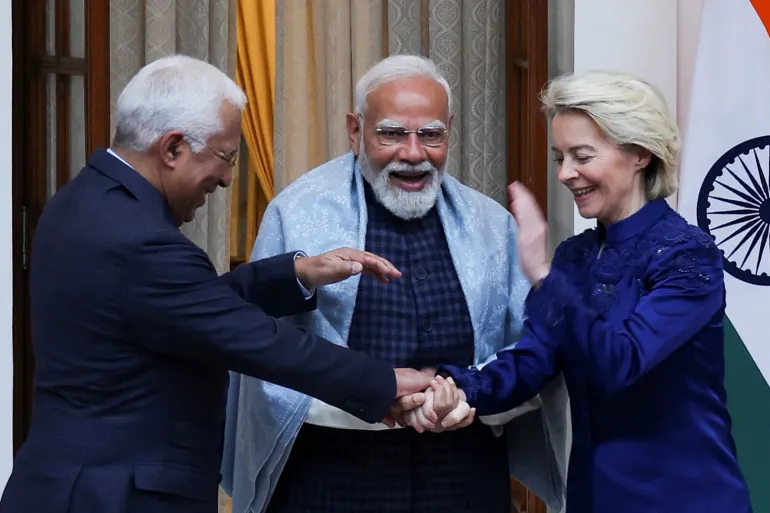
NEW DELHI — In a resounding rebuke to the “America First” protectionism radiating from Washington, India and the European Union on Tuesday finalized a landmark free trade agreement, bringing a dramatic close to two decades of diplomatic stalemate.
Standing in the shadow of President Donald Trump’s escalating global trade war, Prime Minister Narendra Modi and European Commission President Ursula von der Leyen announced the completion of what they dubbed the “mother of all deals.” The pact creates a staggering free trade zone of two billion people, representing 25% of global GDP and a third of all world trade.
“At a time of turmoil in the global order, this partnership will strengthen stability,” Prime Minister Modi told a packed news conference in Delhi. “Today, India and Europe are making history.”
The ‘Trump Impulse’
While negotiations for the India-EU Free Trade Agreement (FTA) first began in 2007, they had spent the better part of twenty years gathering dust. The sudden acceleration of the talks—reaching a fever pitch over the last six months—is widely viewed as a direct consequence of the “Trumpian shock” to the global system.
The President’s recent moves have fundamentally altered the risk calculus for both New Delhi and Brussels:
- Targeting India: Trump has slapped 50% tariffs on key Indian exports, partly as punishment for India’s continued purchase of Russian oil.
- Coercing Europe: The EU is still reeling from the President’s threat to impose 25% tariffs on allies who opposed his administration’s bid to acquire Greenland.
- The Isolation Effect: U.S. Treasury Secretary Scott Bessent admitted on Tuesday that the U.S. is feeling “isolated” as its traditional partners forge ahead with their own networks.
“The turmoil caused by the Trump administration’s tariff policies has clearly sharpened minds,” said Jörn Fleck, senior director of the Atlantic Council’s Europe Center. “Antagonism from the United States provided the immediate impetus to get this done.”
A Tale of Two Giants
The deal is far more than a defensive crouch; it is a massive structural realignment of the world’s second and fourth-largest economies. By slashing trade barriers that have historically been among the highest in the world, the pact promises a radical exchange of goods and expertise.
Key Breakthroughs of the Deal:
- Automotive: India will slash its prohibitive 110% import duties on European cars (including Volkswagen, Renault, and Mercedes-Benz) down to a flat 10%.
- Luxury & Agri-food: Prohibitive tariffs on European wine, chocolates, and olive oil will be eliminated or drastically reduced.
- Labor Mobility: In a major win for New Delhi, the EU will grant “privileged access” to highly skilled Indian professionals, facilitating a surge of talent into Europe’s IT and healthcare sectors.
- Strategic Diversification: The EU aims to double its goods exports to India by 2032, reducing its 17.3% trade dependency on the United States.
Strategic Shielding
Beyond the balance sheets, the agreement includes a framework for deeper defense and security cooperation. With the U.S. increasingly weaponizing trade to achieve territorial and geopolitical aims—from Greenland to the South China Sea—India and the EU are attempting to “Trump-proof” their future.
The deal also serves as a hedge against China. By creating a robust alternative supply chain, Brussels and Delhi hope to reduce their reliance on Chinese manufacturing while simultaneously sidestepping the “100% tariff” threats Trump has leveled at neighbors like Canada for engaging with Beijing.
| Factor | Previous Status | New FTA Status |
| Market Size | Fragmented | 2 Billion Consumers |
| Average Tariffs | Up to 110% (India) | Near Zero on 97% of goods |
| U.S. Leverage | High (Primary Partner) | Diminishing (Diversified) |
| Labor Flow | Restrictive | Ease of Mobility for Professionals |
The Outside Looking In
As the formal signing ceremony concludes in New Delhi, the geopolitical landscape has shifted. The United States, once the architect of global trade, now finds itself on the outside of the world’s most significant new economic corridor.
While von der Leyen hailed the deal as a “signal to the world that rules-based cooperation still delivers,” the subtext was clear: the world is no longer waiting for Washington. In the “Age of Trump,” the “mother of all deals” has proven that the most effective response to a tariff wall is a bridge built elsewhere.