
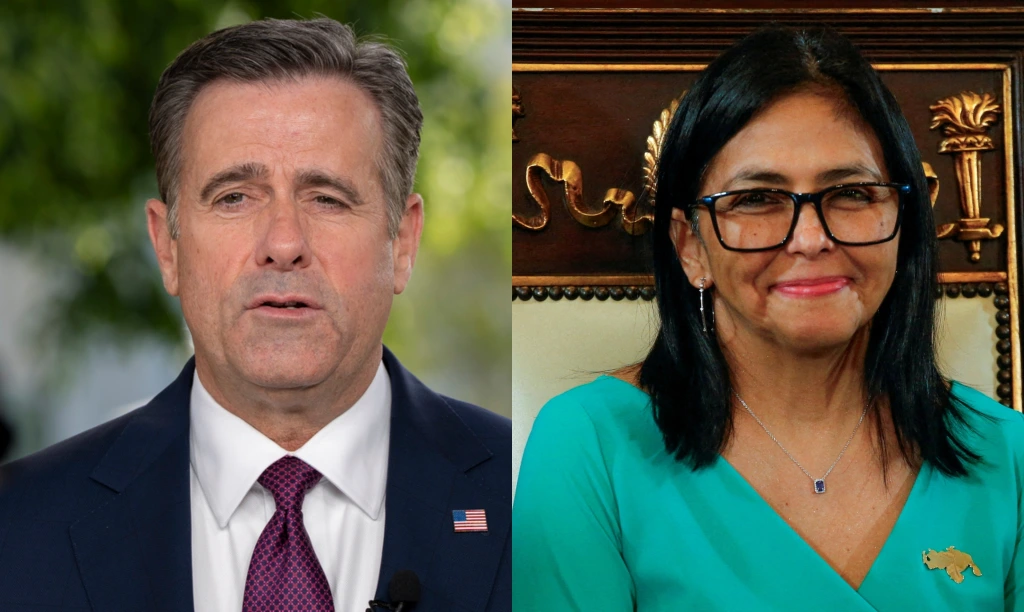
CARACAS — In a high-stakes mission that signals a tectonic shift in U.S.–Latin American relations, CIA Director John Ratcliffe landed in Caracas on Thursday for a clandestine two-hour meeting with Venezuela’s interim leader, Delcy Rodríguez.
The visit, confirmed by senior U.S. officials and first reported by The New York Times, marks the highest-level direct engagement between Washington and Caracas since the U.S. military operation that captured and removed Nicolás Maduro earlier this month. The meeting at the Miraflores Presidential Palace serves as a blunt acknowledgment from the Trump administration: despite years of sanctions and rhetoric, Rodríguez—a veteran regime insider—is now Washington’s preferred partner for a “stable” transition.
“Director Ratcliffe was there to deliver a very specific message,” a senior intelligence official told reporters. “The United States is ready for a working relationship, but Venezuela can no longer serve as a safe haven for narco-traffickers or the strategic assets of our adversaries.”
A Pragmatic Pivot
The summit represents a “risk-taking” evolution for the CIA under Ratcliffe, who reportedly sought the meeting to bypass traditional diplomatic channels and establish a direct line of “intelligence cooperation.”
The two-hour dialogue focused on three critical pillars:
- Counter-Narcotics: Ratcliffe reportedly presented Rodríguez with a “non-negotiable” list of cartel and ELN (National Liberation Army) hubs that the new government must dismantle.
- Economic Stabilization: Discussions included a framework for the “orderly” return of American oil majors like Exxon and Chevron to the Orinoco Belt.
- The ‘Safe Haven’ Mandate: In no uncertain terms, Ratcliffe signaled that Russian and Chinese military influence in the country must be “phased out” in exchange for the lifting of personal and state sanctions.
The ‘Rodriguez’ Paradox
For many in the Venezuelan opposition, Ratcliffe’s visit is a bitter pill. While the U.S. has publicly championed democratic reformers, the administration has pivoted toward Rodríguez, the former Vice President, as the figure best positioned to maintain control over the country’s powerful military and security apparatus.
“She is the only one who can keep the generals in their barracks,” said one regional analyst. “The CIA isn’t looking for a Jeffersonian democracy right now; they are looking for a reliable manager who won’t let the country slide into civil war.”
Rodríguez, for her part, has navigated this “new political moment” with calculated precision. While she continues to publicly decry the “kidnapping” of Maduro—who currently awaits trial in a New York federal jail—she has signaled an unprecedented willingness to open the state-run oil industry to Western capital.
A Continent on Edge
The Caracas meeting has sent shockwaves through the region. Neighbors like Colombia and Brazil have expressed concern over the “unilateral” nature of the U.S. intervention, while Moscow has condemned Ratcliffe’s visit as an act of “blatant imperialist coordination.”
Inside the White House, the meeting is being hailed as a masterclass in “Realpolitik.” By installing a regime insider who is “beholden to American security interests,” the administration believes it has achieved what twenty years of sanctions could not: the neutralization of the “Bolivarian” threat to the U.S. southern flank.
As Ratcliffe’s plane departed Caracas for Washington, the question remained whether Rodríguez can truly deliver on her end of the bargain. With the Maduro-loyalist “colectivos” still armed and the military’s true allegiances untested, the CIA’s two-hour gamble is the first step in what will likely be a volatile and high-stakes transformation of the South American power balance.