
Israeli Prime Minister Benjamin Netanyahu announced Sunday that the U.S.-backed Gaza peace plan is poised to enter its highly complex and critical “second phase,” potentially beginning as early as the end of the month. The Prime Minister’s remarks, made alongside German Chancellor Friedrich Merz, signaled an urgent intent to transition from the current fragile truce to the much more daunting tasks of demilitarizing Gaza and establishing a new security framework.
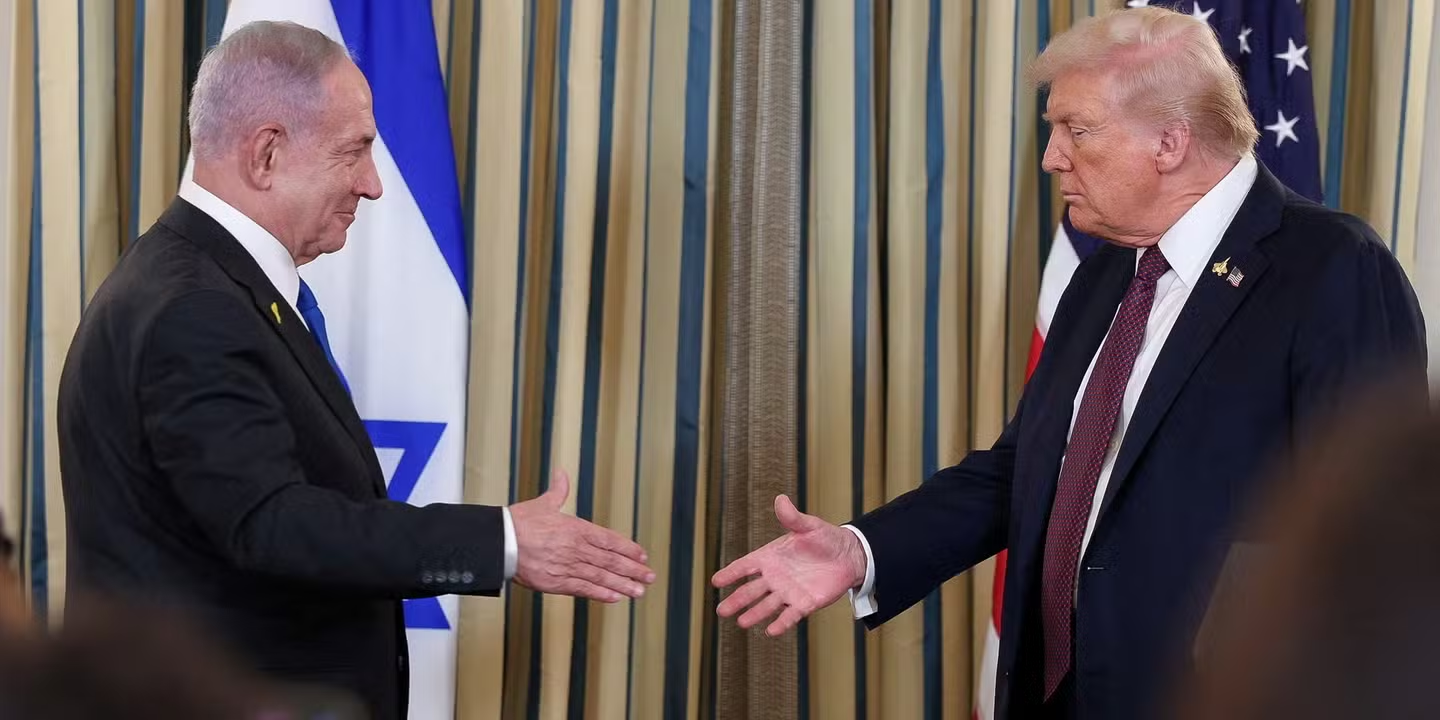
Netanyahu confirmed he will hold crucial discussions with U.S. President Donald Trump later this month to finalize the details of this transition, which includes establishing an international security force and dismantling Hamas’s military infrastructure.
The End of Phase One and the Hardline Demands
The first phase of the peace plan, which took effect on October 10th, successfully secured the release of the remaining 20 living Israeli hostages and 27 bodies in exchange for approximately 2,000 Palestinian prisoners. However, the completion of this phase is contingent on the return of the remains of one final Israeli police officer killed in the initial October 7, 2023, attack.
Netanyahu indicated that this return is imminent, paving the way for the second, much more complex phase.
- Netanyahu’s Focus: The Israeli leader emphasized that the second phase must achieve the “disarmament of Hamas and the demilitarisation of Gaza.” He stressed that this commitment—to neutralize the militant group’s offensive capabilities—is non-negotiable for Israel.”We finished the first part,” Netanyahu stated. “And now we very shortly expect to move into the second phase, which is more difficult.”
- The Three-Step Plan: The Prime Minister also outlined a third, long-term phase: the “deradicalization of Gaza,” which he compared to the post-war reconstruction and ideological shift seen in Germany and Japan.
The International Security Dilemma
Phase Two of the U.S. initiative, which was largely endorsed by the United Nations Security Council, involves a significant change in the security and governance of the Gaza Strip.
- Israeli Withdrawal and Security: Under the plan, Israeli forces are required to withdraw further from the territory they currently control (estimated at 53% of Gaza) to allow for the deployment of a Multinational International Stabilization Force (ISF). This force, backed by an international “Board of Peace” chaired by President Trump, is meant to oversee security.
- Netanyahu’s Skepticism: While supporting the concept of an international force, Netanyahu expressed strong doubts about its ability to enforce Hamas’s demilitarization. “What will be the timeline? What are the forces that are coming in? Will we have international forces? If not, what are the alternatives? These are all topics that are being discussed,” he said, citing them as central unresolved issues.
- Hamas’s Counter-Offer: Despite Netanyahu’s hardline approach, a senior Hamas official, Bassem Naim, suggested the group is open to discussing the possibility of “freezing or storing or laying down” its weapons, an offer viewed by analysts as a significant, though vague, concession.
The Israeli Prime Minister’s commitment to meeting with President Trump before the end of the month confirms the high-level focus on overcoming these obstacles. German Chancellor Friedrich Merz, whose meeting with Netanyahu was held this weekend, stressed the urgency, stating that Phase Two “must come now.”
The ultimate success of Phase Two hinges on two highly uncertain conditions: the complete disarmament of Hamas and the successful deployment of a multinational force, tasks both sides acknowledge are “daunting.”