
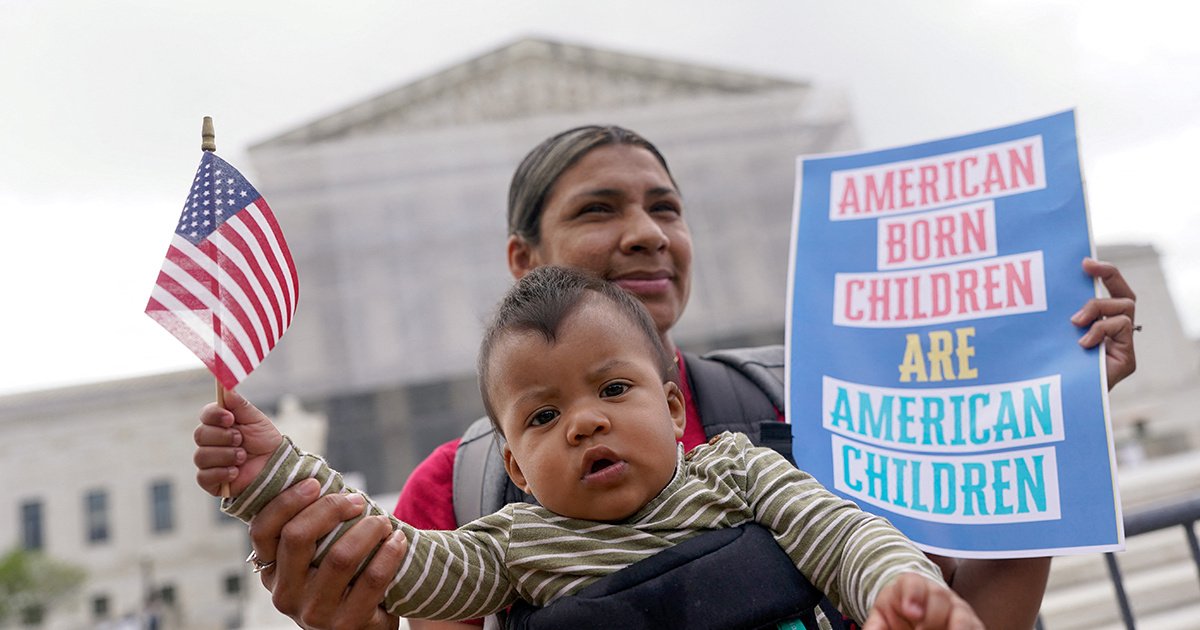
The U.S. Supreme Court on Friday agreed to hear a pivotal case challenging President Donald Trump’s executive order that seeks to restrict birthright citizenship, setting the stage for a dramatic constitutional showdown that could fundamentally reshape the definition of American citizenship.
The justices will review the constitutionality of the President’s directive, which aims to deny U.S. citizenship to children born on U.S. soil if their parents are either in the country without legal authorization or present on a temporary basis, such as student or tourist visas. The case, Trump v. Barbara (and related cases), will be argued in the spring, with a definitive ruling expected by early summer 2026.
The 14th Amendment and 127 Years of Precedent
The ruling will directly address the interpretation of the Citizenship Clause of the 14th Amendment to the U.S. Constitution, which was ratified after the Civil War to secure citizenship for formerly enslaved people.
The clause states: “All persons born or naturalized in the United States, and subject to the jurisdiction thereof, are citizens of the United States and of the State wherein they reside.”
For over 125 years, this clause has been interpreted to mean that nearly everyone born on U.S. soil is an automatic citizen, a principle cemented by the Supreme Court’s 1898 decision in United States v. Wong Kim Ark.
- The Administration’s Argument: The Trump administration, through the Solicitor General, argues that this precedent has been “mistaken” and that children born to parents who are either “unlawfully present” or merely “temporarily” in the country are not “subject to the jurisdiction” of the United States in the way the framers intended. They claim the term implies a deeper, more complete allegiance that undocumented or temporary visitors do not hold.
- The Legal Challenge: Civil rights groups, led by the ACLU, argue that the executive order is a clear violation of the 14th Amendment, a longstanding federal statute, and a century of Supreme Court precedent. They maintain that the only established exceptions to birthright citizenship are the children of foreign diplomats and foreign military forces.
The Impact of the Ruling
The outcome of the case will have massive, far-reaching consequences, extending beyond the legal framework to the humanitarian and political stability of the nation.
- Creating a Subclass: If the Supreme Court sides with the administration, it could instantly render hundreds of thousands of children—and all future children born under these circumstances—non-citizens. Critics warn this would create a new, vulnerable subclass of residents who lack basic rights and could even be rendered stateless, vulnerable to exploitation and deportation to countries they have never known.
- Lower Courts Unanimous: The Supreme Court’s willingness to hear the appeal comes despite the administration’s repeated losses in lower federal courts. Every court that has addressed the constitutionality of the executive order has, so far, found that it likely violates the Constitution, though the orders blocking its implementation were recently narrowed by the Supreme Court.
The Trump administration’s order, signed on the first day of his second term, is the first of his sweeping immigration policies to be definitively evaluated by the Supreme Court on its legal merits. The hearing next spring will force the nation’s highest court to decide whether to uphold a core tenet of American citizenship that has stood since the Civil War, or to fundamentally redefine who belongs in the United States.