
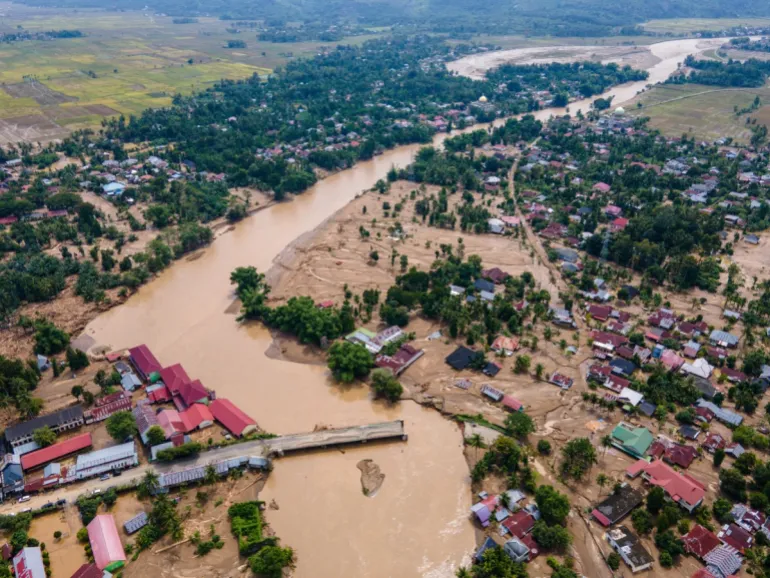
JAKARTA, INDONESIA—A catastrophic convergence of monsoon rains and a rare tropical cyclone has triggered some of the worst flooding in years across Southeast Asia, leaving a trail of devastation that has claimed at least 600 lives across four nations.
As search-and-rescue operations desperately claw through mud and wreckage, authorities warn that the final death toll is certain to rise, with hundreds more individuals still missing across vast, inaccessible swathes of Indonesia, Thailand, Malaysia, and Sri Lanka.
The Cyclone and The Surge
The disaster was intensified by Cyclone Senyar, an exceptionally rare tropical storm that formed near the Malacca Strait, directing a torrent of water onto land already saturated by continuous monsoon downpours.
- Indonesia Bears the Brunt: The island of Sumatra has been hit particularly hard. Indonesia’s National Disaster Management Agency confirmed more than 300 fatalities, primarily in the provinces of Aceh and North Sumatra. Floodwaters, which rose with terrifying speed, swallowed homes, forcing thousands to flee to higher ground. Officials estimate nearly 300 people remain missing.”The current was very fast; in a matter of seconds, it reached the streets and entered the houses,” recounted one resident of Aceh Province, whose home was completely submerged.
- Thailand’s Emergency: In southern Thailand, the situation deteriorated into a humanitarian emergency, with at least 160 deaths confirmed. In Songkhla province, water levels reached three meters (nearly 10 feet), and the city of Hat Yai recorded its heaviest single-day rainfall in three centuries. The massive influx of casualties overwhelmed local facilities, forcing a hospital to bring in refrigerated trucks to store bodies.
- Sri Lanka’s Crisis: Battered by the cyclone, the island nation of Sri Lanka has recorded over 130 deaths and approximately 170 people missing. The severe flooding and landslides have destroyed over 15,000 homes, displacing 78,000 residents, and plunging nearly a third of the country into darkness without power or running water.
Search and Rescue: A Race Against Time
The scale of the destruction has paralyzed regional infrastructure. Key highways are impassable due to landslides, and communication links remain severed in many of the worst-hit areas of Sumatra, compounding the difficulties faced by emergency teams.
Tens of thousands of people have been evacuated, but many hundreds remain stranded on rooftops or cut off in isolated villages, waiting for aid and rescue that is hampered by continuing bad weather.
Meteorologists suggest that the extreme weather patterns are a signature of climate change, interacting with local weather systems to create increasingly violent and unpredictable storms. The region, which often contends with heavy annual monsoon rains, is now grappling with what officials call one of its most destructive weather events in recent history.
As the floodwaters slowly begin to recede in some areas, the focus is shifting from rescue to a massive recovery effort, with governments facing the devastating task of identifying the dead, feeding the displaced, and rebuilding communities that have been physically wiped off the map.