
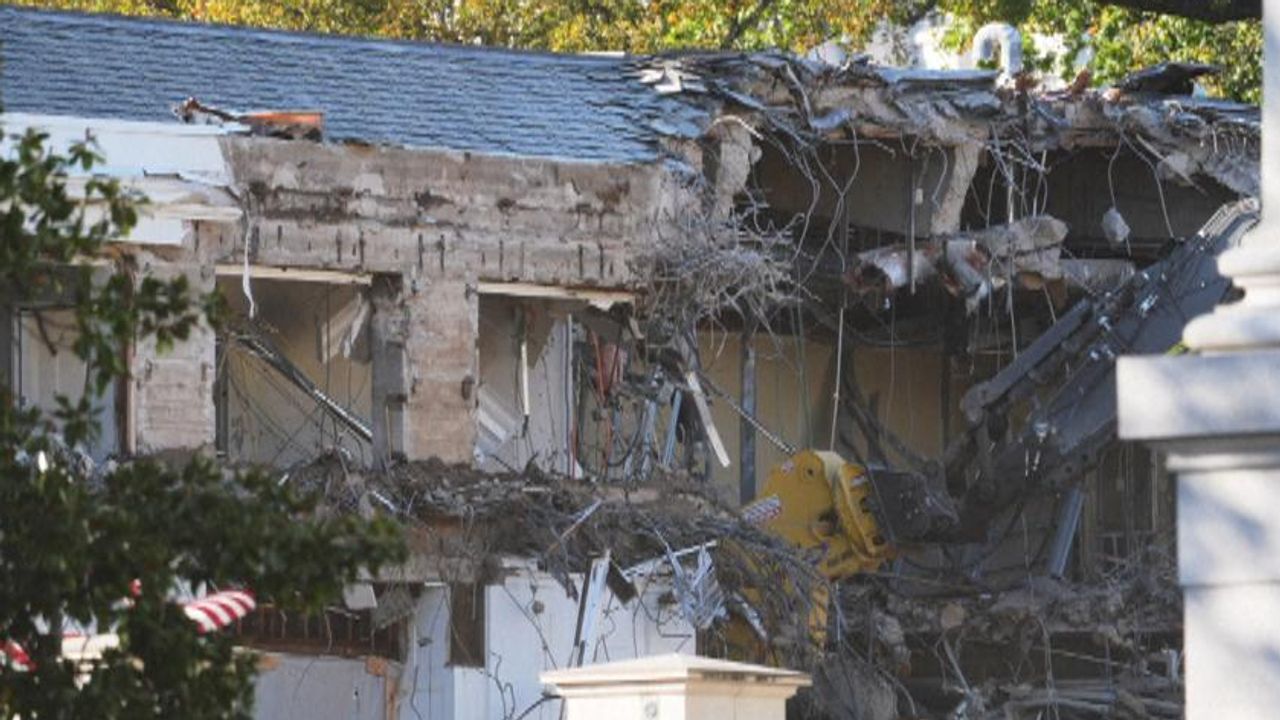
In one of the most drastic physical alterations to the White House in decades, demolition crews have begun tearing down a section of the historic East Wing to make way for President Donald Trump’s long-desired, multi-million dollar “White House Ballroom.”
Images of excavators ripping into the 1942-era structure—the traditional home of the First Lady’s office and the main visitors’ entrance—have sparked immediate outrage from preservationists and political rivals, who decry the move as an “utter desecration” of a national landmark.
The President confirmed the start of the controversial $250 million project on his social media platform, announcing that “ground has been broken” on the “new, big, beautiful White House Ballroom.” He claimed the idea of such a space has been a presidential dream for over 150 years and vowed it would be completed at “zero cost to the American Taxpayer” through private donations.
A Contradictory Construction
The start of the demolition directly contradicts earlier promises from the White House. In July, President Trump had assured the public that the new structure would be “near it but not touching it” and would “pay total respect to the existing building.” White House Press Secretary Karoline Leavitt had previously stated, “Nothing will be torn down.”
However, photos distributed late Monday showed construction heavy machinery visibly gutting the façade of the East Wing, leaving the structure—which sits over the Presidential Emergency Operations Center (PEOC) bunker—compromised to clear the way for the massive 90,000-square-foot extension.
The enormous new venue, which is being designed with opulence reminiscent of the President’s private clubs and is planned to seat up to 999 guests, will dwarf the capacity of the current largest space, the historic East Room.
The Cost of Vision: Money, History, and Compliance
The project is being funded by an undisclosed list of wealthy corporate and individual “Patriots” who have contributed to the estimated $250 million price tag, a move that critics warn creates ethical gray areas regarding access and influence.
Beyond the aesthetics, the move raises serious questions about proper federal oversight. The demolition has commenced without explicit final sign-off from the National Capital Planning Commission (NCPC), the agency responsible for approving major construction on federal property in Washington. The head of the NCPC, a Trump appointee, had previously stated that the commission’s jurisdiction did not extend to demolition work.
The East Wing, originally added by Theodore Roosevelt in 1902 and substantially renovated in 1942 under Franklin D. Roosevelt, has served as a symbol of the First Lady’s expanded role. The displacement of the First Lady’s staff offices—the nerve center for initiatives pioneered by figures like Eleanor Roosevelt and Laura Bush—is seen by many as a symbolic erasure of that legacy.
As the sounds of construction now echo across the South Lawn, President Trump’s “visionary addition” has become the largest structural modification to the Executive Mansion since the Truman Reconstruction in the late 1940s, cementing his reputation not just as a president, but as the great rebuilder—or destroyer—of America’s most famous residence.