
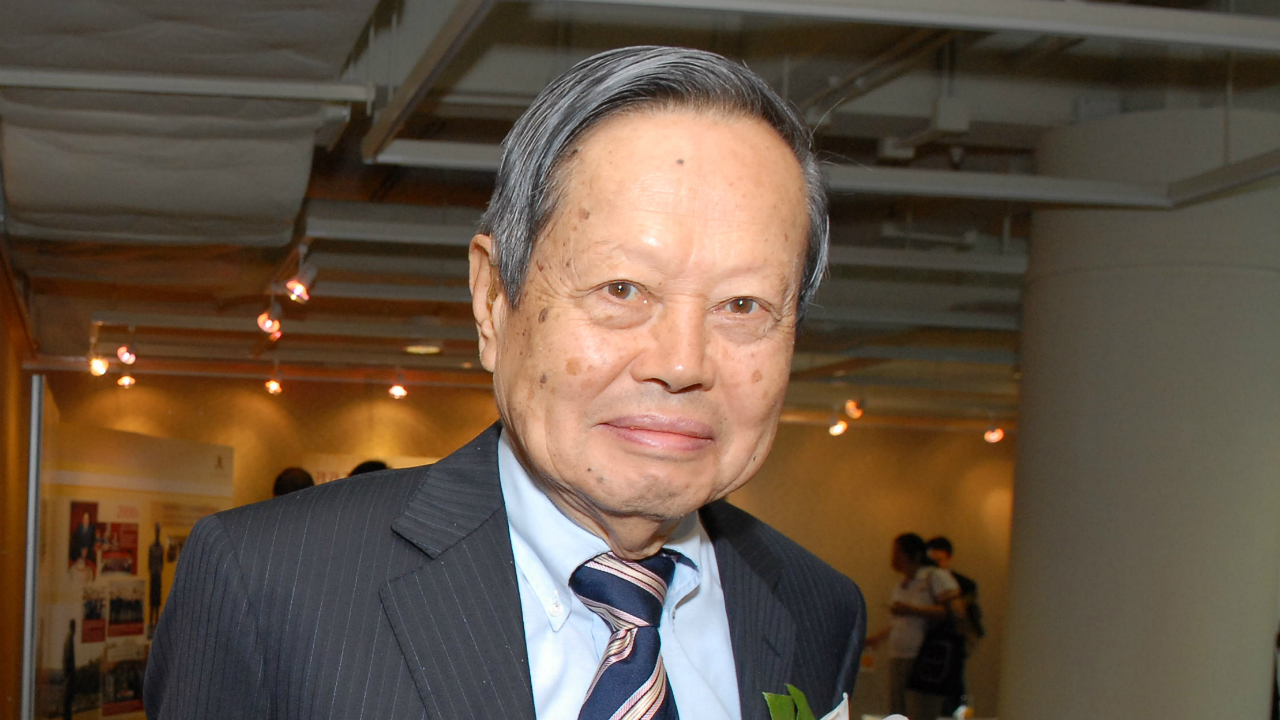
BEIJING— The world of physics is mourning the loss of one of its true giants. Chen Ning Yang, the pioneering Chinese-American theoretical physicist whose work fundamentally reshaped our understanding of the universe’s most basic forces, has died in Beijing at the age of 103.
Tsinghua University, where Yang served as a professor in his later years, confirmed his passing on Saturday, calling his century-long life an “immortal legend” that forever changed global science and education.
The Cornerstones of Quantum Theory
Dr. Yang’s monumental career is defined by two breakthroughs that stand as cornerstones of modern physics, placing him in the pantheon alongside figures like Einstein and Maxwell.
1. The Violation of Parity (1957 Nobel Prize)
In 1957, Chen Ning Yang and his colleague Tsung-Dao Lee were jointly awarded the Nobel Prize in Physics for their revolutionary work that overturned a long-held fundamental law: the Conservation of Parity.
Physicists had long assumed that the laws of nature were perfectly symmetrical—that a phenomenon and its mirror image would behave identically. Yang and Lee mathematically challenged this assumption regarding the weak interaction, one of nature’s four fundamental forces. Their theory, which proposed that weak interactions violate this left-right symmetry, was quickly confirmed by the Wu experiment, sending shockwaves through the scientific community. At 35, Yang became one of the youngest Nobel laureates in history and, with Lee, the first Chinese-born scientist to receive the award.
2. The Yang-Mills Theory (1954)
Perhaps Yang’s most enduring legacy is the Yang-Mills theory, which he co-authored with Robert Mills in 1954. This set of mathematical equations created the framework for non-abelian gauge theory, which describes how three of the four fundamental forces—the electromagnetic, weak, and strong interactions—operate. The Yang-Mills theory would later become the essential mathematical foundation for the Standard Model of particle physics, the reigning theoretical model that unifies these forces and classifies all known elementary particles.
A Life Bridging Cultures and Inspiring China
Born in Hefei, China, in 1922, Yang’s academic journey took him to the United States in the 1940s, where he earned his Ph.D. from the University of Chicago and later spent years at Princeton’s Institute for Advanced Study and Stony Brook University.
His personal life was a powerful reflection of his dual heritage. As he accepted his Nobel Prize, he expressed his profound awareness of being “a product of both the Chinese and Western cultures, in harmony and in conflict.”
After the thaw in US-China relations, Yang returned to the mainland in 1971—the first high-profile visit by an overseas Chinese scholar—and became a tireless advocate for rebuilding and advancing basic scientific research in his homeland. In his later years, he dedicated himself to nurturing talent at Tsinghua University, profoundly impacting a new generation of Chinese physicists.
Chen Ning Yang’s influence stretched far beyond particle physics, with seminal contributions to statistical mechanics, including the famous Yang-Baxter equation. His passing closes a historic chapter in the development of modern science, leaving behind a profound intellectual legacy that continues to inform and inspire physicists around the globe.