
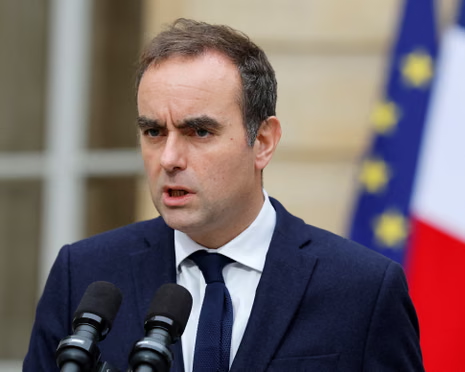
PARIS, FRANCE—In a dramatic concession to stave off the collapse of his minority government, French Prime Minister Sébastien Lecornu announced Tuesday he would suspend President Emmanuel Macron’s signature and deeply unpopular 2023 pension reform.
The stunning political pivot—which puts on hold the plan to raise the retirement age from 62 to 64 until after the 2027 presidential election—is a direct exchange of a major economic policy for immediate political survival.
Facing two motions of no-confidence this week, Lecornu needed to win over the crucial swing votes of the Socialist Party (PS). His gambit appears to have succeeded, with the Socialist parliamentary leader hailing the move as a “victory” and signaling the party would not vote to topple the government—for now.
“I will propose to parliament, starting this autumn, that we suspend the 2023 pension reform until the presidential election,” Lecornu told a tense National Assembly to applause from the Left benches. He guaranteed that “No increase in the retirement age will take place from now until January 2028.”
The Price of Stability
The suspension of the pension overhaul, which sparked months of mass protests when it was controversially forced through parliament without a final vote in 2023, is a bitter pill for President Macron. The reform was intended to be a central pillar of his legacy, aimed at balancing the country’s struggling retirement system.
However, the political turmoil unleashed by last year’s snap elections—which resulted in a hung parliament—has left France’s government perpetually on the brink. With two of Lecornu’s predecessors already toppled by no-confidence votes, sacrificing the pension increase was deemed the only way to ensure the survival of his cabinet and secure passage of a critical 2026 austerity budget.
Lecornu emphasized that the move was not a financial windfall, estimating the cost of the suspension at €400 million in 2026 and €1.8 billion in 2027, which he said would need to be offset by corresponding savings.
A New Pledge to Parliament
Beyond the pension freeze, the Prime Minister offered another key olive branch to the fragmented National Assembly: a pledge not to use the widely condemned Article 49.3 of the Constitution. This special power allows a government to bypass a parliamentary vote, the very mechanism used to force through the pension reform last year.
“I will no longer use Article 49.3,” Lecornu asserted, promising that all major bills, including the budget, would now go to a final vote. “The government will make suggestions, we will debate, and you will vote.”
The immediate response from the political flanks was one of cynical relief. While the conservative Les Républicains (LR) confirmed they would not join the no-confidence motions, the far-right National Rally and the radical-left France Unbowed—who both filed censure motions—mocked the move as a desperate act.
National Rally leader Jordan Bardella derided the fragile coalition as an “friendly circle of Emmanuel Macron’s saviours,” unified only by a “fear of the ballot box.”
For President Macron, now grappling with his sixth prime minister in two years, the suspension marks a significant political retreat. But for a nation paralyzed by political deadlock and mounting debt, the sacrifice of his signature reform buys a precious moment of stability, however costly and fleeting it may prove to be. The ultimate showdown on the government’s survival is set for Thursday, when the no-confidence motions are debated.