
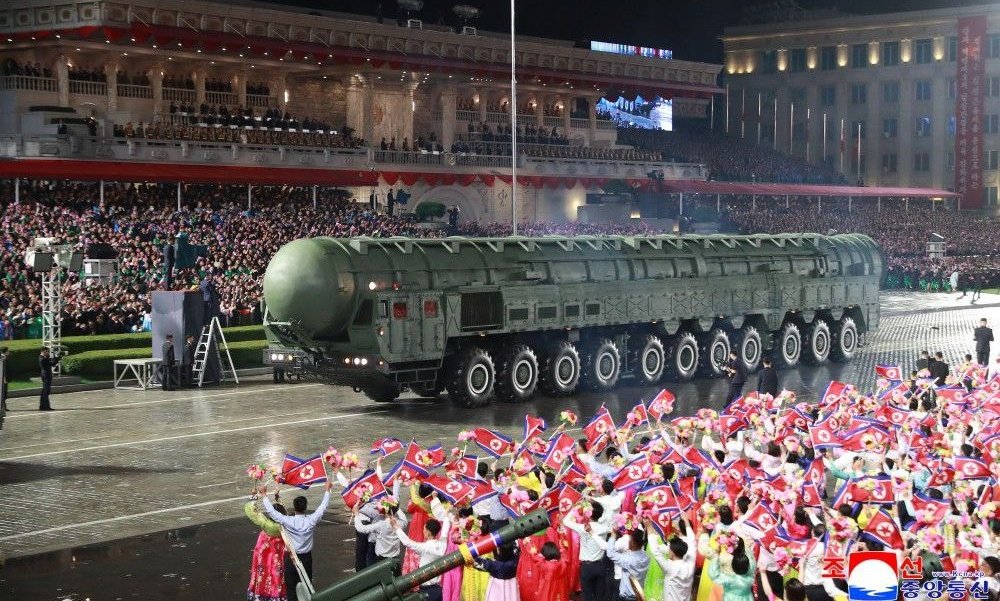
PYONGYANG— Under the floodlights of Kim Il Sung Square, North Korea’s military spectacle reached its crescendo Friday night as the regime rolled out its latest and most formidable weapon: the Hwasong-20 Intercontinental Ballistic Missile (ICBM). Described by state media as the nation’s “most powerful nuclear strategic weapon system,” the massive missile dominated a rare parade attended by high-level dignitaries from China and Russia, underscoring Pyongyang’s accelerated drive for nuclear deterrence and its increasingly assertive diplomatic pivot.
The late-night parade, held to mark the 80th anniversary of the ruling Workers’ Party of Korea, transformed the capital into a potent display of military might and geopolitical alignment. Leader Kim Jong Un, flanked by Chinese Premier Li Qiang and Russia’s Dmitry Medvedev, presided over columns of goose-stepping soldiers and a staggering array of new weaponry.
The Apotheosis of Ambition
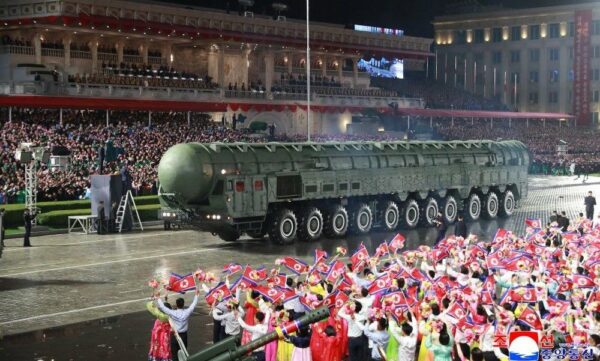
The star of the show, the Hwasong-20, appeared on an imposing 11-axle transporter-erector-launcher (TEL). Though yet to be flight-tested, analysts believe the new ICBM is a significant technical leap, likely designed to carry multiple re-entry vehicles (MRVs) or a more sophisticated multiple independently targetable re-entry vehicle (MIRV) payload.
This potential capability is a direct challenge to the United States and its allies, as a multi-warhead missile would severely complicate and stress existing missile defense systems.
“The Hwasong-20 represents, for the moment, the apotheosis of North Korea’s ambitions for long-range nuclear delivery capabilities,” noted Ankit Panda of the Carnegie Endowment for International Peace. “We should expect to see the system tested before the end of this year.”
The parade also prominently featured the Hwasong-11Ma hypersonic missile, a solid-fuel weapon prized for its maneuverability and faster launch preparation time—a key development that drastically shrinks the reaction window for U.S. and South Korean forces.
A New Axis of Defiance
The presence of top officials from Beijing and Moscow was as significant as the missiles on display. The rare attendance of such senior figures highlighted Kim’s success in forging a stronger anti-West front, leveraging global tensions to break out of international isolation.
In his address, Kim Jong Un pledged to develop an “invincible entity that destroys all threats,” but notably refrained from directly naming the United States or South Korea. He did, however, offer “warm encouragement” to North Korean troops sent to support Russia’s war efforts in Ukraine, a gesture that underscored the deepening military-strategic partnership between Pyongyang and Moscow.
Analysts suggest this display of advanced weaponry, coupled with the attendance of allied leaders, serves a dual purpose: internally, it validates Kim’s single-minded pursuit of nuclear strength under the banner of “self-defense,” and externally, it signals a firm, non-negotiable status as a nuclear-armed power on the world stage.
With the largest and most complex missile yet revealed, the Hwasong-20 is a looming shadow—a bold declaration that Pyongyang’s nuclear program is neither temporary nor up for negotiation. The only question now is when and where the missile will be tested, signaling the start of the next major cycle of tension on the Korean Peninsula.