
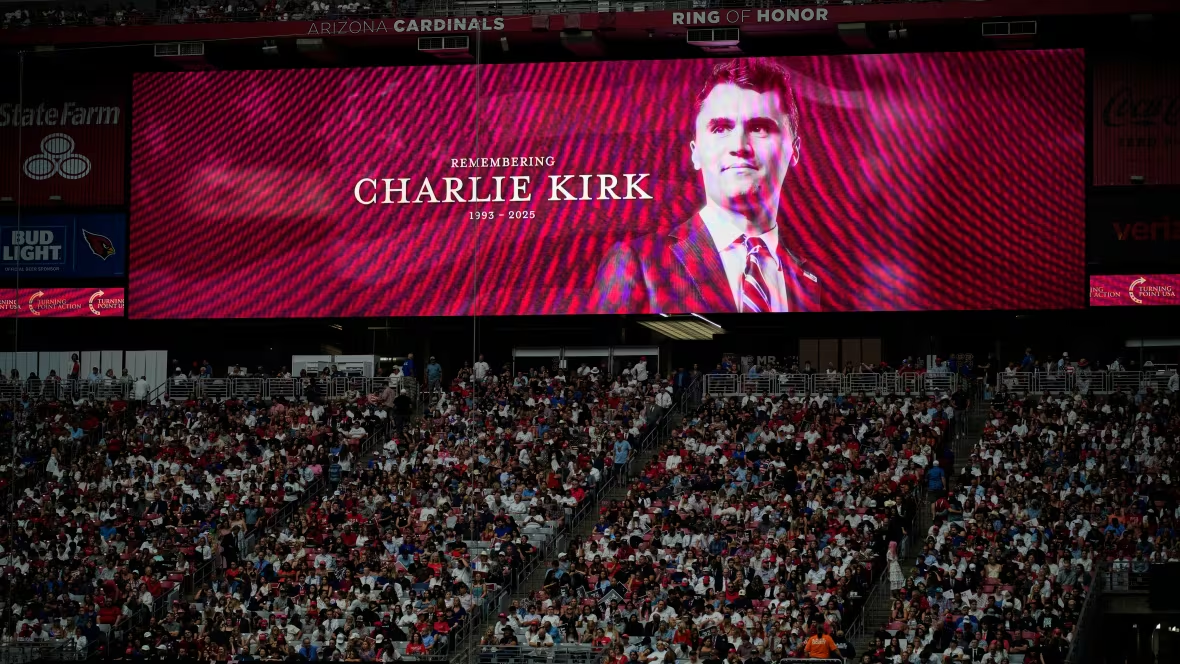
The memorial service for conservative activist Charlie Kirk was more than just a tribute to a fallen figure; it was a powerful and revealing fusion of religious fervor and political zeal that offered a glimpse into the future of the MAGA movement, a future where faith is not just an undercurrent but a central, defining force. The solemn tribute quickly morphed into a spiritual revival and a political rally, with speakers on the stage and thousands in the audience weaving a narrative where politics and a perceived “spiritual war” are one and the same.
The event at State Farm Stadium, which began with Christian worship music, was a masterclass in this blending of sacred and profane. As attendees waved “Never Surrender” signs alongside Bibles, a rotating cast of speakers framed Kirk’s life not in political terms alone, but in a divine context. Kirk was repeatedly called a “martyr,” a “prophet,” and a “warrior for Christ.” Rob McCoy, Kirk’s pastor, declared that Kirk “looked at politics as an on-ramp to Jesus,” a powerful articulation of a new political-religious fusion.
The ideological poles of the movement were on full display in the speeches of its two most prominent voices. Charlie Kirk’s widow, Erika Kirk, who was named the new CEO of Turning Point USA, delivered the emotional core of the service. She tearfully announced she had forgiven her husband’s killer, a message she said was inspired by Christ and her late husband. She vowed to continue his work through the newly created “Turning Point USA Faith,” which will aim to recruit thousands of new pastors and congregations.
Immediately following her plea for forgiveness, President Donald Trump took the stage. His address was a powerful and stark contrast to hers, as he praised Kirk as “a martyr for American freedom” and “our greatest evangelist.” But in a viral, unscripted moment, he veered from his prepared remarks to declare, “He did not hate his opponents. He wanted the best for them. That’s where I disagreed with Charlie. I hate my opponent, and I don’t want the best for them.” The moment, which drew both laughter and applause, crystallized a central conflict within the new movement’s soul.
Other speakers, including Vice President J.D. Vance and White House Deputy Chief of Staff Stephen Miller, took a more belligerent tone. Miller delivered a fiery, apocalyptic speech, telling an undefined “you” that “You are nothing. You are wickedness. You are jealousy, you are envy, you are hatred. You are nothing.” For his part, Vance wove personal anecdotes about Kirk’s faith into a broader political message, a move seen by many as a clear effort to position himself as the heir apparent to Trump by bridging the gap between the populist base and the Christian conservative movement.
The memorial was not just a tribute to a political leader; it was a powerful re-affirmation of a movement that is increasingly defining itself not by policy, but by a mission that its followers believe is both political and sacred. The fusion of the cross and the campaign, on full and unblinking display in a football stadium in Arizona, suggests that the MAGA movement is charting a new, and potentially more powerful, course for its future.