
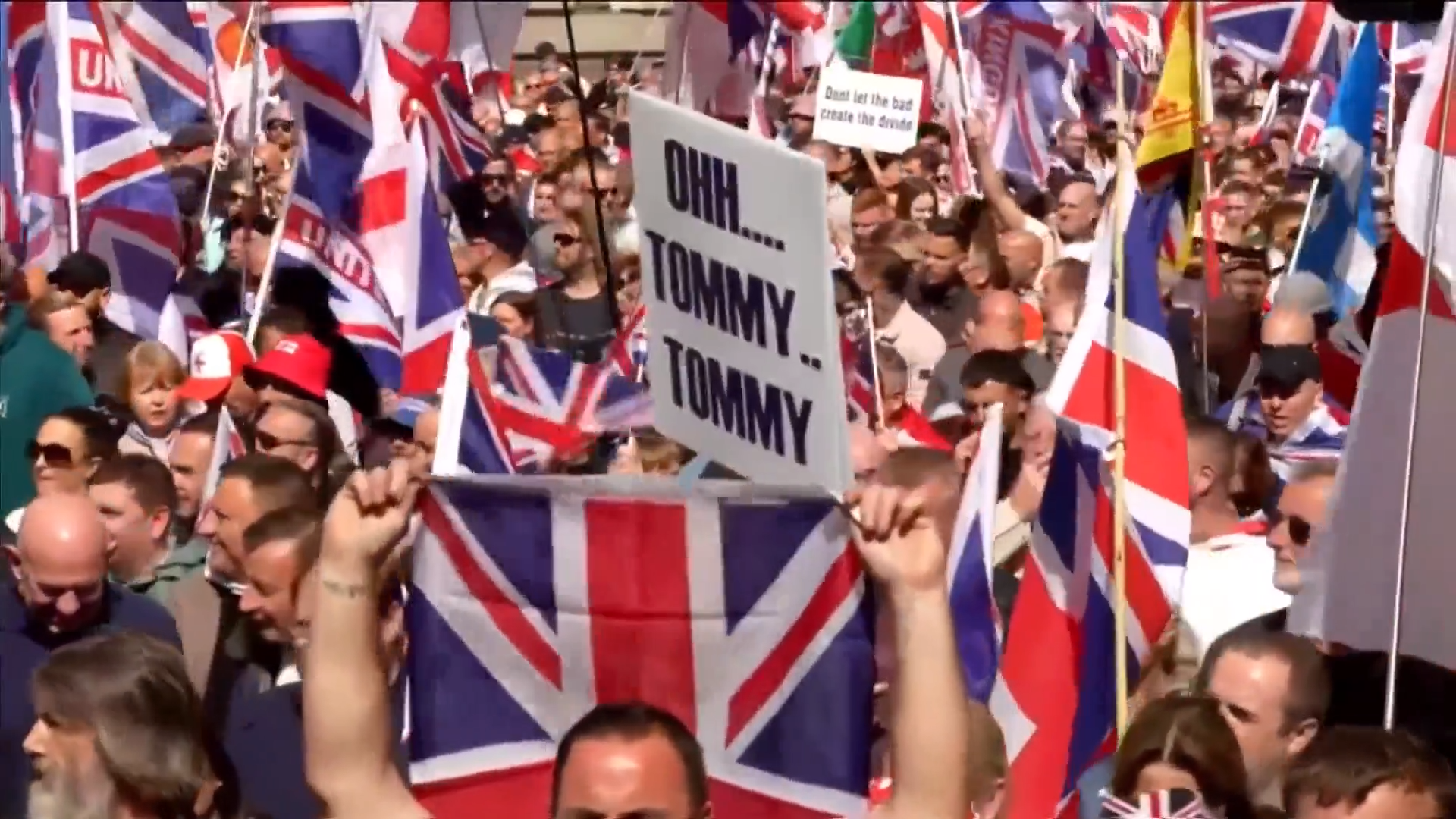
A vast crowd of more than 100,000 demonstrators, mobilized by far-right activist Tommy Robinson, marched through central London on Saturday in a controversial “Unite the Kingdom” rally that saw a small number of protesters clash with police and counter-protesters. While the march was ostensibly for “free speech,” its themes were fiercely anti-immigrant and nationalist, reflecting the deepening political polarization that has gripped the UK.
The day began with two opposing rallies converging on Whitehall, the heart of the British government. Robinson’s “Unite the Kingdom” march, estimated by the Metropolitan Police to number around 110,000 people, dwarfed the rival “March Against Fascism,” organized by Stand Up to Racism, which drew around 5,000. Police deployed a force of over 1,600 officers to keep the groups separate, a challenge that proved difficult as the massive crowds of the main rally swelled and became unruly.
Tensions flared in the late afternoon. Police reported that some supporters of the “Unite the Kingdom” march threw bottles and other projectiles at officers and tried to breach police cordons. Nine arrests were made on the day, with police vowing to pursue others identified on camera. The incidents stand in stark contrast to previous large demonstrations, such as the pro-Palestinian marches, which have been largely peaceful.
The rally was a powerful display of nationalist sentiment. Protesters, many waving the St. George’s Cross of England and the Union Jack, chanted “We want our country back” and carried placards with slogans like “stop the boats” and “send them home,” referencing the contentious issue of undocumented migrants crossing the English Channel. The crowd was also addressed by several prominent far-right figures, including French politician Éric Zemmour and U.S. billionaire Elon Musk, who appeared via video link and called for a “change of government” in Britain.
The rally was also fueled by the recent fatal shooting of American conservative activist Charlie Kirk. Several speakers and demonstrators paid tribute to Kirk, with one sign reading, “Freedom of speech is dead. RIP Charlie Kirk.” This emotional connection to a high-profile American political figure added an unexpected international dimension to the domestic protest, linking it to the wider global rise of far-right movements.
For the UK, the mass demonstration is a stark reminder of the country’s deep divisions. While the rally was framed as a show of national unity, its message was one of exclusion and hostility towards immigrants, putting Prime Minister Keir Starmer’s government in a difficult position. The Home Secretary, Shabana Mahmood, has condemned the violence against police, while opposition leaders have called for the government to take a harder line against the far-right. As the political rhetoric continues to heat up, the events of Saturday serve as a chilling warning that the fight for Britain’s future is no longer confined to the halls of power, but has spilled into the streets.