
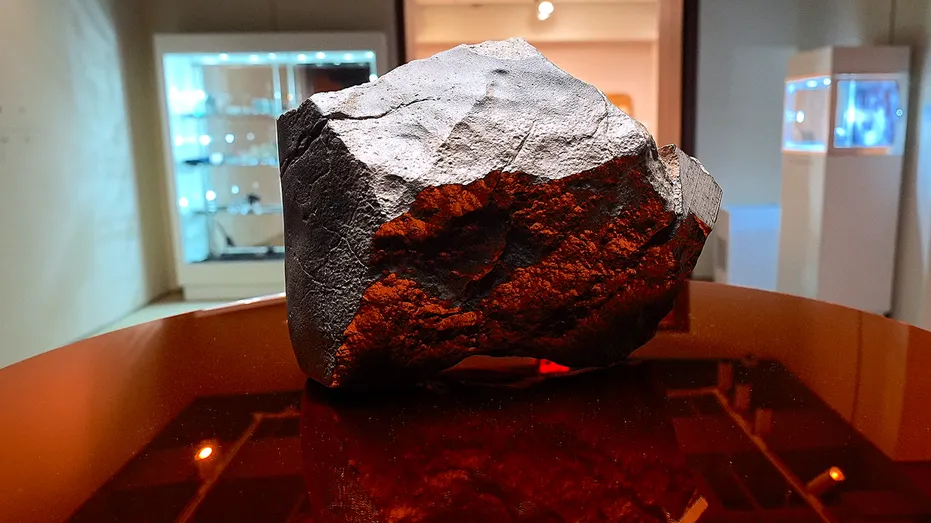
The discovery of a rare Martian meteorite in the remote Agadez region of Niger has sparked an international controversy, as the country’s government launches a high-stakes investigation into how the precious rock ended up being sold for a record-breaking $5.3 million at a Sotheby’s auction in New York. The sale, which was finalized last month, has prompted outrage from scientists, cultural heritage advocates, and Nigerien officials who are now demanding the immediate return of what they consider a national treasure.
The meteorite, officially known as Northwest Africa 16788 (NWA 16788), is a colossal 54-pound rock that represents nearly 7% of all Martian material ever found on Earth. According to Sotheby’s, it was blasted off the surface of Mars by an ancient asteroid impact and traveled 140 million miles before landing in the Sahara Desert, where it was discovered by a meteorite hunter in November 2023.
But for the government of Niger, the meteorite’s origin is less important than its final destination. In an official statement, Nigerien authorities raised suspicions of illegal international trade and tasked the Ministries of Justice, Mines, and Higher Education with conducting a thorough inquiry into how the meteorite was exported.
“It was discovered in Niger? How come it ended up being sold in New York?” said Alia Baré, the daughter of former Nigerien president Ibrahim Baré Maïnassara, in an interview with Forbes Africa. “This is a national treasure that shouldn’t have been sold. Things have to change.”
Largest Mars Rock Ever Found on Earth Sells for $5.3 Million at Auction
The sale has reignited a long-simmering debate about the legal and ethical ownership of extraterrestrial objects found in developing nations. While some countries, like Argentina, have laws that classify meteorites as cultural treasures, many others do not have explicit legislation on the matter, creating a legal gray area that collectors and dealers often exploit. The “NWA” (Northwest Africa) designation itself, which applies to thousands of meteorites, is a result of this lack of regulation, as it is used when the exact place of recovery is not known.
Sotheby’s has maintained that the meteorite was “shipped and transported in line with the standard procedure of all meteorites that come out of Niger” and that “all relevant documentation was in order at each stage of its journey.” However, the auction house has not revealed the identity of either the seller or the anonymous buyer, fueling speculation and hindering Niger’s investigation.
For now, the fate of the priceless rock remains in limbo. Scientists are also concerned that the meteorite’s value could put it in the hands of a private collector who may not allow it to be studied, a loss to the scientific community. The controversy in Niger serves as a powerful reminder of the complex legal and ethical questions that arise when a rock from space becomes a commodity on Earth, and it is a stark new chapter in the ongoing struggle of African nations to protect their natural and scientific heritage from foreign exploitation.