
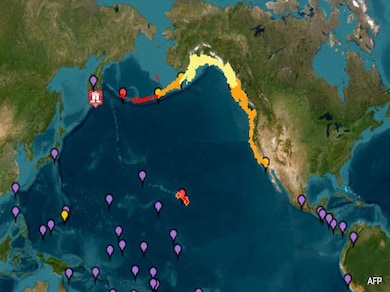
A sigh of relief swept across North America’s Pacific coast today as tsunami warnings and advisories were largely downgraded or canceled, hours after a powerful magnitude 8.8 earthquake off Russia’s Far East sent terrifying waves rippling across the vast ocean. While some localized impacts were observed, the feared catastrophic inundation did not materialize, a testament to robust early warning systems and swift public response.
The colossal tremor struck early Wednesday morning (local time in Kamchatka), triggering immediate tsunami alerts across the Pacific Basin. Fears were particularly high in Hawaii and along the U.S. West Coast, regions with a history of devastating tsunami impacts. Sirens blared in Hawaii, prompting widespread evacuations of coastal areas, while officials in California and Oregon urged residents to seek higher ground and stay away from beaches and harbors.
In Hawaii, the initial tsunami warning, the highest level of alert, was downgraded to an advisory after waves ranging from 1.2 to 1.8 meters (4 to 6 feet) were recorded at various gauges. While water was observed receding from some shorelines, a classic sign of an approaching tsunami trough, the expected destructive surges did not arrive. Hawaii Governor Josh Green confirmed that evacuation orders were lifted, commercial ports were cleared for reopening, and airports resumed flights, allowing evacuees to return home. “Everything has been OK so far, we haven’t seen a big wave,” Governor Green stated earlier, though cautioning that waves would continue for several hours.
Along the U.S. West Coast, tsunami activity was also observed. In Northern California, Crescent City, a town with a painful history of tsunamis, reported maximum wave heights of 1.1 meters (3.6 feet). While sufficient to cause minor coastal flooding and inundation in low-lying areas, it fell short of a major destructive event. Tsunami advisories were also in effect for parts of Oregon and Washington state, though these were later canceled as the threat diminished. The National Weather Service in Los Angeles had warned of a “rapid and damaging surge” of ocean water in places like Port San Luis, moving from low to high tide within minutes, but the overall risk subsided.
U.S. Secretary of Homeland Security Kristi Noem provided a reassuring update, stating that the threat of a major tsunami hitting the United States “has passed completely.” However, authorities across the affected North American coastlines continued to urge vigilance, reminding the public that even smaller tsunami waves can generate dangerous currents and unpredictable sea level fluctuations for many hours after the initial arrival. Swimmers, boaters, and those near the water were advised to remain cautious.
The event underscored the immense power of earthquakes originating along the “Ring of Fire,” the seismically active zone where the quake originated. It also highlighted the crucial role of sophisticated tsunami warning centers, like the Pacific Tsunami Warning Center (PTWC) in Honolulu, which rapidly analyze seismic data and issue alerts, providing vital minutes or hours for communities to prepare and evacuate.
While the situation in North America de-escalated, parts of South America, including Chile and Ecuador, remained on heightened alert and proceeded with coastal evacuations, as tsunami waves can travel across vast distances and impact different coastlines at varying times and intensities.
For North America, however, the immediate crisis has averted, concluding a tense few hours that served as a stark, yet ultimately non-catastrophic, reminder of the ever-present geological forces shaping the Pacific.