
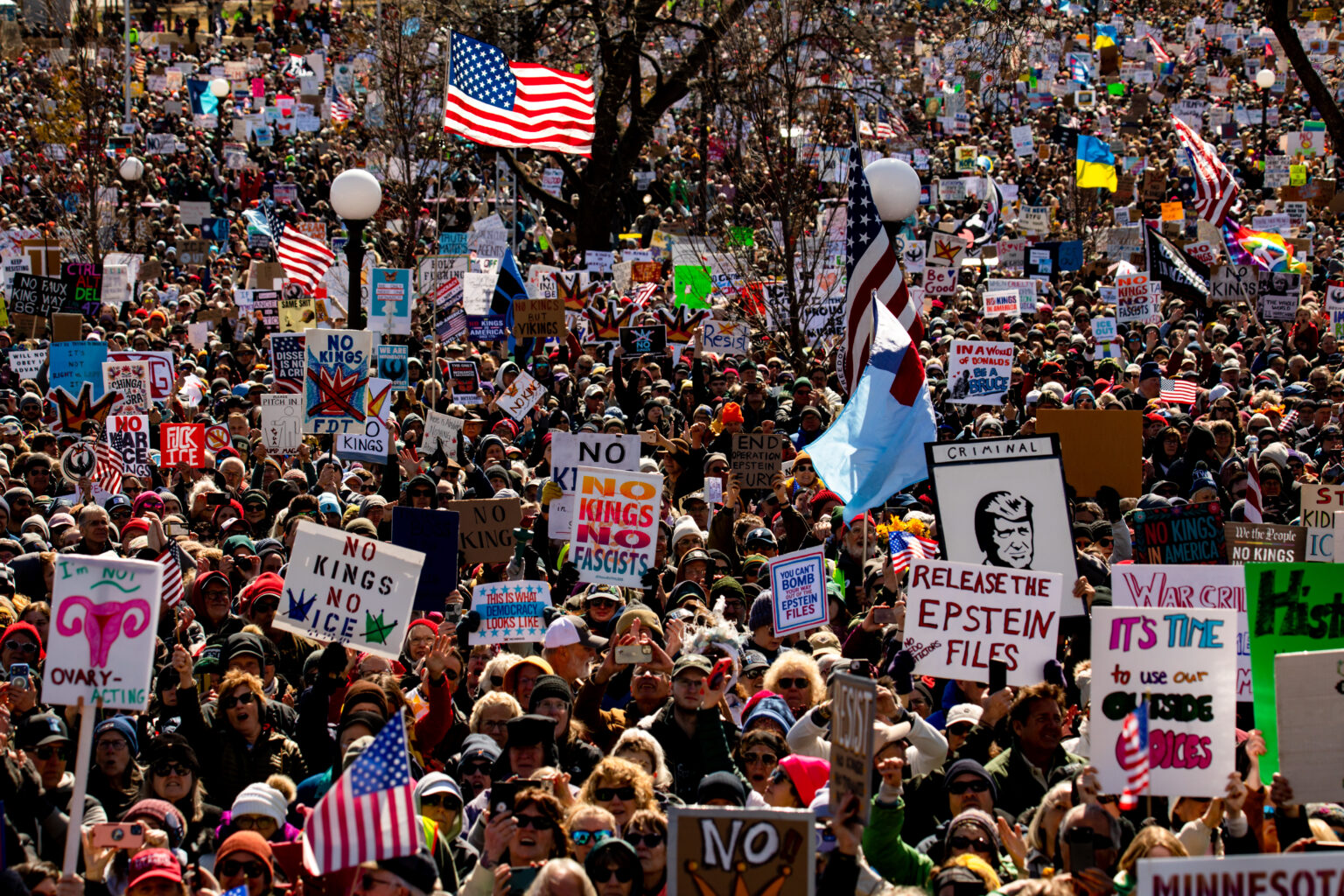
ST. PAUL, Minn. — In the biting chill of a Minnesota spring, the American political landscape shifted under the weight of millions of boots. On Saturday, March 28, the “No Kings” movement—a sprawling, leaderless coalition that has become the primary conduit for opposition to the second Trump administration—staged its third and largest nationwide mobilization to date.
From the concrete canyons of Manhattan to the quiet town squares of the Mountain West, an estimated 8 million people took to the streets. While previous rallies in 2025 focused on administrative overreach, the 2026 iteration, dubbed “No Kings 3.0,” carried a darker, more urgent tone, fueled by the outbreak of war in Iran and a domestic immigration crackdown that has turned the Twin Cities into a national flashpoint.
The Epicenter: St. Paul’s General Strike
While Washington D.C. saw tens of thousands gather at the Lincoln Memorial, the movement’s flagship event took place in St. Paul, Minnesota. The state has become the symbolic heart of the resistance following “Operation Metro Surge”—a hardline federal immigration push that resulted in the fatal shootings of residents Renée Good and Alex Pretti by federal agents earlier this year.
Under the shadow of the State Capitol, a crowd exceeding 200,000 stood shoulder-to-shoulder. The atmosphere was a surreal blend of somber vigil and high-stakes political rally. Bruce Springsteen headlined the event, his gravelly anthems providing a soundtrack to a crowd that included Senator Bernie Sanders and Governor Tim Walz.
“We are not a kingdom; we are a republic,” Sanders told the roaring assembly. “And in a republic, the people—not the billionaires, not the generals, and certainly not the President—are the final authority.”
Image source: Minnesota Reformer
A Movement Without a Center
What distinguishes “No Kings” from the protest movements of the previous decade is its deliberate lack of a central hierarchy. Coordinated by groups like Indivisible and 50501, the movement functions as a “container” for a wide array of grievances.
In Bethesda, Maryland, protesters gathered outside the National Institutes of Health to decry cuts to medical research. In Chicago, an estimated 200,000 people focused on the humanitarian crisis at the border. In Philadelphia, the focus remained on the escalating conflict in the Middle East.
“You can’t decapitate a movement that doesn’t have a head,” said one organizer in San Diego, where 40,000 people formed a human banner on Ocean Beach.
This amorphous nature has allowed the movement to penetrate beyond “deep blue” urban centers. Organizers reported a 40% jump in events held in smaller, traditionally conservative communities in states like Idaho, Alabama, and Kansas. In these areas, the “No Kings” message often pivoted toward economic concerns, citing rising living costs and the fiscal toll of the new war.
The White House Response
The Trump administration has remained predictably defiant. On Saturday evening, White House spokesperson Abigail Jackson dismissed the demonstrations as “the product of leftist funding networks” and labeled them “Trump Derangement Therapy Sessions.”
Earlier in the day, Donald Trump Jr. mocked the protesters from a business summit, suggesting the turnout was exaggerated by a “complicit media.”
However, the sheer scale of the March 28 rallies suggests a level of sustained civil engagement that historical data rarely sees this far into a presidential term. With the 2026 midterm elections looming in November, Democratic leaders are banking on this street-level energy translating into a seismic shift in congressional power.
The Long Road to November
As the sun set on Saturday, the papier-mâché effigies were folded away, and the drumlines grew quiet, but the logistical machinery of “No Kings” shows no signs of slowing. The movement has transitioned from a series of “moments” into a permanent “relay race,” handing off the energy of mass marches to local organizing, “ICE watch” groups, and voter registration drives.
The “No Kings” rallies of March 2026 have proven that while the administration may hold the levers of federal power, the argument over the soul of American governance is being settled in the streets. As one hand-painted sign in Washington put it: “The crown doesn’t fit.”