
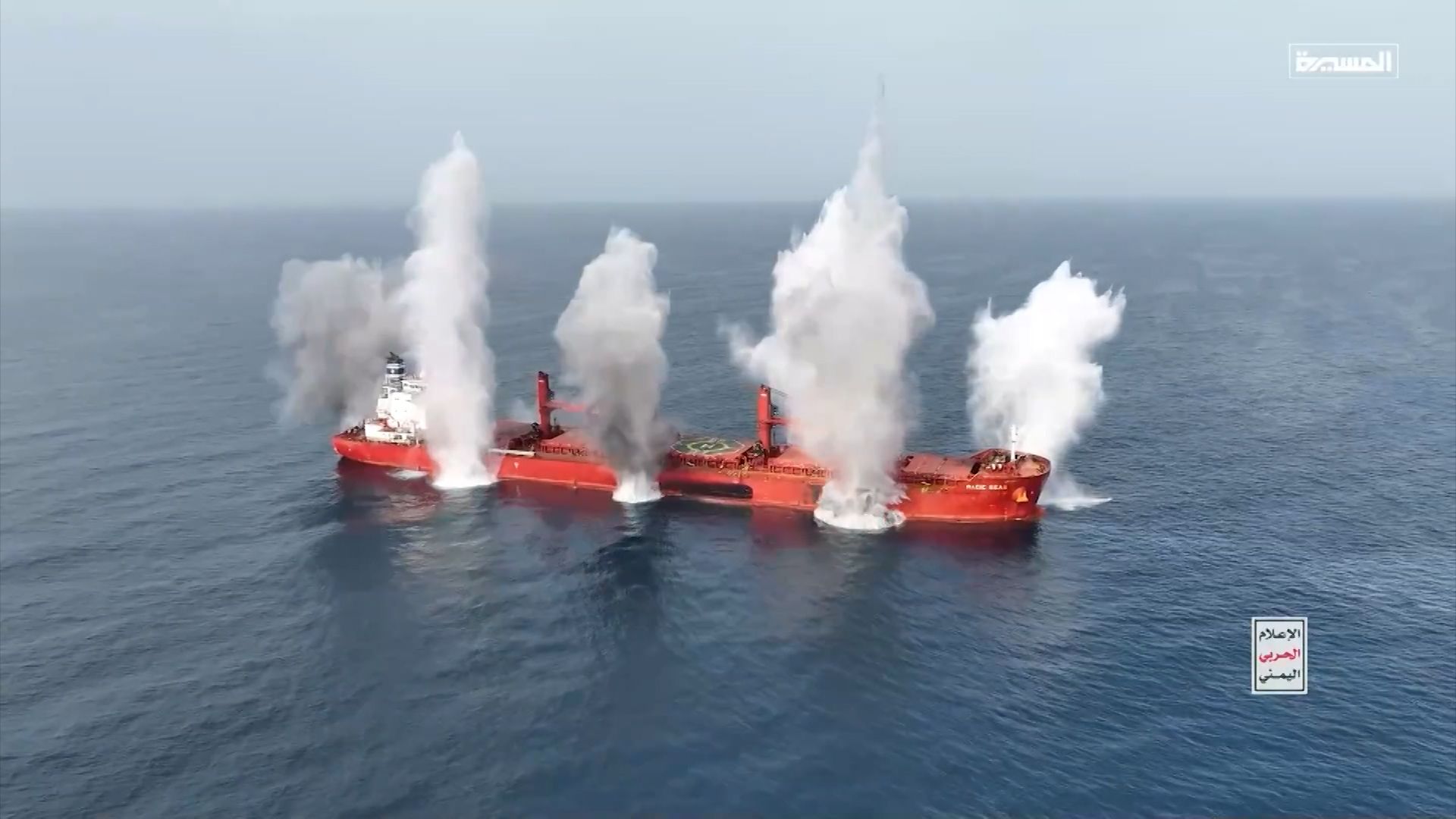
SANA’A / LONDON — For a few brief months in early 2026, the global shipping industry allowed itself a sigh of relief. The jagged coastline of Yemen seemed quieter, the “war risk” premiums began to soften, and the great container armadas of Maersk and MSC cautiously signaled a return to the Suez Canal. But that window of normalcy is slamming shut.
As of late March 2026, a renewed surge in Houthi military activity and a series of “strategic warnings” from the group’s leadership have thrust the Red Sea back into a state of high-alert. This is no longer just a regional skirmish; it is a structural threat to a global economy that is already walking a tightrope of recovery.
The “Structured Pause” Ends
Throughout 2025, Houthi attacks on commercial vessels saw an 84% decline compared to the chaos of 2024. Analysts called it a “strategic recalibration.” However, the events of the past 48 hours suggest the “pause” was merely a period of rearmament. Following a barrage of Houthi missiles launched toward Israel on March 28, EUNAVFOR ASPIDES—the EU’s maritime protection force—issued a “high” threat level for any vessel with even tangential links to Western or Israeli interests.
The geography of the crisis remains its most potent weapon. The Bab el-Mandeb Strait, a narrow 20-mile-wide “Gate of Tears,” acts as the throat of global trade. When that throat constricts, the symptoms are felt in grocery aisles in Berlin and auto plants in Tokyo.
The Economic Toll: From Cents to Percentages
The potential for a renewed, sustained blockade presents a nightmare scenario for central banks still struggling to anchor inflation. The mechanics of the damage are relentless:
- The Cape Reroute: Shipping giants have already begun reversing their return to Suez, diverting vessels around the Cape of Good Hope. This adds up to 14 days of transit time and roughly $1 million in additional fuel costs per voyage.
- The Capacity Crunch: By diverting around Africa, the effective global shipping capacity drops by approximately 9%. This isn’t just a delay; it is a physical shortage of available “space” on the ocean.
- The Inflationary Lag: J.P. Morgan research suggests that persistent disruptions in this corridor could add up to 0.7 percentage points to global core goods inflation. In an era of high interest rates, this “maritime tax” could be the difference between a soft landing and a global recession.
A New Kind of “Dual-Route Equilibrium”
What makes 2026 different from the initial 2023 shocks is the realization that this threat is now structural. Logistics experts are observing a “dual-route equilibrium,” where the Cape of Good Hope is no longer a temporary detour but a permanent, high-cost necessity for risk-averse carriers.
The Houthis have demonstrated an “asymmetric leverage” that defies traditional naval deterrence. While a single Houthi drone costs a few thousand dollars, the missiles used by Western navies to intercept them cost millions. This cost-benefit imbalance has allowed a non-state actor to hold 12% of global maritime trade hostage with relatively low-tech hardware.
The Fragile Outlook
As the “medium” to “high” threat levels persist, the question for 2026 is whether the global supply chain can withstand a second “Long Winter.” With the Strait of Hormuz also facing periodic “security closures” and the Panama Canal still recovering from climate-driven droughts, the Red Sea is the final pillar of a crumbling maritime architecture.
“We are seeing the weaponization of geography,” says one senior maritime analyst. “If the Red Sea remains a ‘no-go’ zone through the summer of 2026, the cost won’t just be measured in fuel and insurance—it will be measured in the permanent restructuring of how the world buys and sells.”
For now, the world watches the Yemeni coast, where a few well-placed missiles have proven they can move the needle of the global GDP more effectively than any central bank.