
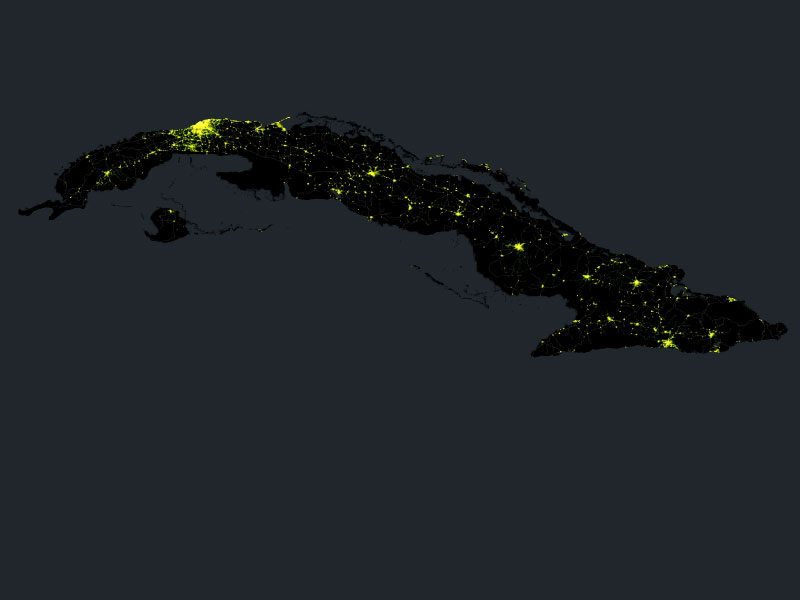
HAVANA — For the second time in six days, the rhythmic hum of Havana’s street life has been replaced by a heavy, tropical silence. On Saturday evening, March 21, 2026, Cuba’s national electric grid suffered a catastrophic failure, plunging nearly 10 million people into a total blackout and pushing an already exhausted nation to the brink of a humanitarian emergency.
The collapse occurred at approximately 6:32 p.m. local time, triggered by what the Ministry of Energy and Mines described as an “unexpected failure” at the Nuevitas thermoelectric plant in Camagüey. The malfunction sparked a cascading effect across the island’s fragile, Soviet-era infrastructure, which was already struggling to recover from a similar nationwide outage that began on Monday, March 16.
“This is becoming unbearable,” Ofelia Oliva, a 64-year-old Havana resident, told reporters as she navigated a pitch-black street by the light of her cell phone. “It hasn’t even been a week since the last one. People are tired; they are hungry; and now, we are in the dark again.”
A Perfect Storm: Infrastructure and the Oil Blockade
While technical failures are the immediate cause, the roots of the crisis are deeply geopolitical. Since the beginning of 2026, the island’s energy sector has been starved of its lifeblood: imported oil.
The transition of power in Venezuela in early January—resulting in the capture of President Nicolás Maduro—has effectively severed Cuba’s primary energy artery. Under the “Year of the Fire Horse” administration, Washington has enforced a stringent oil blockade, threatening heavy tariffs on any nation, including Mexico, that attempts to supply the Caribbean island with fuel.
- Zero Imports: Maritime trackers confirm that no major oil shipments have reached Cuba’s key ports since the first week of January.
- The 40% Deficit: President Miguel Díaz-Canel recently admitted that the country is currently operating on just 40% of the fuel required to maintain a stable grid.
- Aging Giants: The Antonio Guiteras plant, the island’s largest power generator, remains plagued by recurring breakdowns, unable to find the spare parts or high-grade fuel necessary for consistent operation.
The Human Toll: Water, Health, and Hunger
The blackout is not merely an inconvenience; it is a systemic threat to survival. In Cuba, where 84% of water pumping equipment relies on the electrical grid, a national blackout quickly becomes a water crisis.
In hospitals across the provinces, surgical schedules have been shredded, and medical staff are once again forced to rely on aging diesel generators—many of which are low on fuel—to keep “vital centers” like intensive care units functioning. Domestic life has been equally upended; without refrigeration, meager food supplies are spoiling in the Caribbean heat, forcing families to cook communal meals over charcoal fires in the streets.
Dissent in the Shadows
The darkness has provided a veil for rare and increasingly bold displays of public frustration. Last weekend, protesters in the town of Morón reportedly set fire to a local Communist Party headquarters, while “cacerolazo” protests—the rhythmic banging of pots and pans—have become a nightly chorus in parts of central Havana.
Unauthorized demonstrations remain illegal on the island, and the government has labeled recent acts of property damage as “vandalism,” leading to several arrests. However, the sheer scale of the energy failure is making traditional methods of social control difficult to maintain.
A Geopolitical Standoff
The crisis comes as President Trump maintains a hardline stance, suggesting that a “friendly takeover” or a total collapse of the current administration is a condition for lifting the fuel embargo. While Cuban officials have signaled an openness to “broad talks,” they have remained firm that the nation’s political system is not on the negotiating table.
As the Ministry of Energy activates “micro-islands” of power to prioritize hospitals, the broader restoration of the National Electric System (SEN) is expected to take days. For the people of Cuba, the “Purple Dawn” seen in other parts of the world this week feels a world away; here, the only lights visible are the distant stars and the occasional flickering lantern of a fisherman on the Malecón, waiting for a morning that feels increasingly uncertain.