
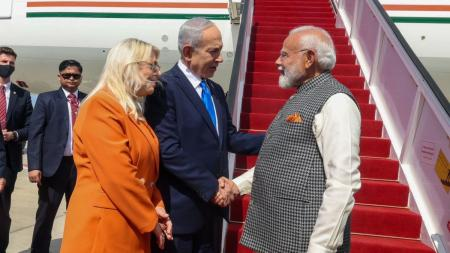
JERUSALEM — Beneath the arches of the Knesset and against a backdrop of the most volatile regional tensions in a generation, Indian Prime Minister Narendra Modi arrived in Israel on Wednesday for a landmark two-day state visit.
The trip, his second since the historic 2017 breakthrough, is being framed by Tel Aviv as a “powerful alliance of two global leaders.” But for New Delhi, the visit is a high-stakes test of its “strategic autonomy”—a delicate balancing act between a burgeoning military partnership with Israel and the vital economic and energy ties it maintains with the Arab world and Iran.
A ‘Hexagonal’ Vision: Beyond Defense
While defense remains the bedrock of the relationship—India remains Israel’s largest arms purchaser—the 2026 agenda signals a shift toward high-tech integration. Prime Minister Benjamin Netanyahu has hailed the visit as a “major diplomatic victory,” specifically looking to cement a “hexagonal alliance” involving India, Greece, Cyprus, and various Arab partners to counter what he terms “radical axes” in the region.
The 2026 Cooperation Blueprint:
- Missile Defense: Discussions are underway for the joint development of advanced ballistic missile defense systems.
- Artificial Intelligence: A new “Innovation Axis” aimed at linking Israeli startups with India’s massive digital infrastructure.
- Labor Mobility: Following the Gaza conflict, India has moved to send thousands of skilled workers to Israel to replace Palestinian laborers, a move critics call support for the Israeli war economy but New Delhi frames as pragmatic “skilled migration.”
The ‘De-Hyphenation’ Dilemma
Modi’s visit comes at a moment of significant regional “hypersensitivity.” While the Prime Minister will address the Knesset and meet with President Isaac Herzog, there is notably no meeting with Palestinian leaders on this itinerary.
This “de-hyphenation”—treating Israel and Palestine as separate, independent relationships—is a hallmark of the Modi era. However, the optics are increasingly difficult to manage:
- The Delhi Declaration: Just weeks ago, at a summit in New Delhi, India joined Arab nations in calling for a “sovereign, independent, and viable state of Palestine” based on 1967 borders.
- The observer Role: In a sign of its reluctance to pick sides in the U.S.-led “Board of Peace” for Gaza’s reconstruction, India opted for “observer status” rather than full membership, signaling it will not be a junior partner in Washington’s regional architecture.
The Turkish and Iranian Shadows
The visit is also a pointed message to Turkey, which has increasingly aligned with Pakistan. By strengthening ties with the “moderate axis” of Israel, Greece, and Cyprus, India is effectively creating a maritime and security counter-weight in the Eastern Mediterranean.
More pressing is the threat of escalation between the United States and Iran. With President Trump’s naval buildup in the Persian Gulf and the threat of kinetic strikes, India is in a precarious position. Millions of Indian nationals live in the Gulf, and their remittances are the lifeblood of the Indian economy. Any strike that triggers Iranian retaliation against Gulf facilities would be a direct blow to New Delhi’s national interests.
The Moral Compass vs. Realpolitik
As the “Mother of Democracy” and a self-appointed leader of the Global South, India faces mounting pressure to leverage its “friendship” with Netanyahu to push for a lasting ceasefire in Gaza. While Modi has condemned the October 7 attacks and expressed “ironclad support” for Israel’s security, his silence on the rising death toll in Gaza has drawn fire from domestic opposition and anti-colonial critics.
“India is trying to show it can be a partner in innovation and security while avoiding the regional mud-wrestling,” said one foreign affairs analyst in New Delhi. “But in the ‘Year of the Fire Horse,’ where events move at a gallop, staying on the fence is becoming an increasingly narrow path.”
As the two leaders review their “Strategic Partnership” over the next 48 hours, the world will be watching to see if Modi can maintain his balance—or if the gravity of the Middle East’s new reality finally forces a tilt.