
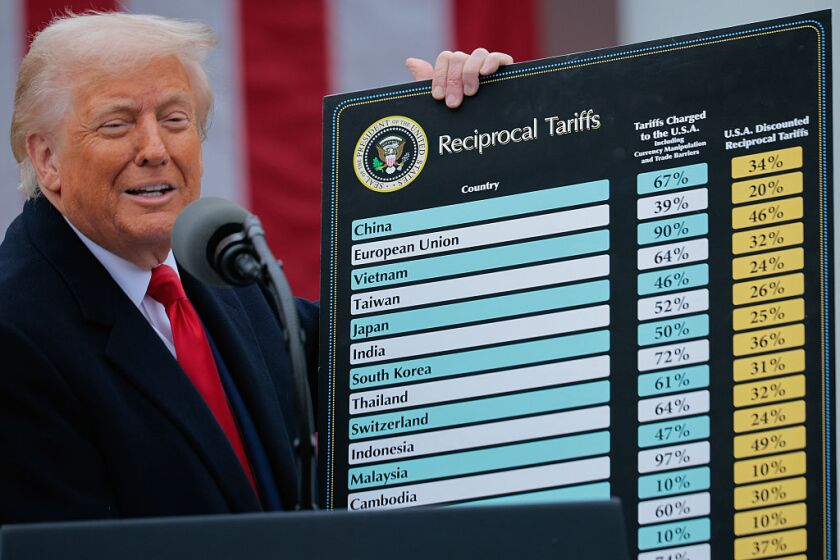
Less than 24 hours after a stinging defeat at the Supreme Court, President Donald Trump has declared open war on the nation’s judicial constraints, announcing an immediate escalation of global trade levies to 15 percent.
The move, announced Saturday via Truth Social, is a direct retort to the high court’s Friday ruling, which struck down the President’s previous tariff regime as an unconstitutional overreach of executive power. Rather than retreating, a defiant Trump has pivoted to a rarely used 1974 trade law to not only restore the duties but to increase them by half.
“Based on a thorough, detailed, and complete review of the ridiculous, poorly written, and extraordinarily anti-American decision issued yesterday… the Trump Administration will soon announce legally permissible tariffs,” the President wrote. “I am, effective immediately, raising the 10% Worldwide Tariff to the fully allowed, and legally tested, 15% level.”
The Legal Maneuver: Section 122
The President’s new strategy rests on Section 122 of the Trade Act of 1974. While the Supreme Court ruled that the International Emergency Economic Powers Act (IEEPA)—the foundation of Trump’s 2025 trade policy—could not be used to bypass Congress on taxes, Section 122 provides a specific, albeit temporary, loophole.
- The 150-Day Clock: The law allows a president to impose a temporary import surcharge of up to 15 percent for 150 days to address “large and serious” balance-of-payment deficits.
- The Legislative Cliff: After the five-month window expires, the administration must secure congressional approval to maintain the rates—setting up a gargantuan political showdown on Capitol Hill this summer.
- The Strategy: The White House is treating this as a “stopgap” measure, buying time to draft permanent, “court-proof” legislation while keeping the pressure on global trading partners.
Markets in Turmoil, Allies in Revolt
The 15 percent hike—which the White House says will go into effect at 12:01 a.m. ET on Tuesday, February 24—has sent shockwaves through global capitals.
In Berlin, Chancellor Friedrich Merz warned of the “poison” of persistent trade uncertainty, announcing he would lead a coordinated European delegation to Washington to protest the move. In Paris, President Emmanuel Macron offered a pointed reminder of the “rule of law,” suggesting that France would pursue “reciprocity” rather than being “subjected to unilateral decisions.”
Who is hit?
- The Global Baseline: Nearly all countries not covered by specific exemptions face the 15 percent levy.
- The Exemptions: The White House confirmed that USMCA-compliant goods from Canada and Mexico remain exempt, alongside critical minerals, certain pharmaceuticals, and fertilizers that cannot be produced domestically.
- The Stacking Effect: These new duties stack on top of existing industry-specific tariffs on steel, aluminum, and semiconductors, which were enacted under different laws and remain unaffected by the Supreme Court’s ruling.
The Economic Gamble
While the President maintains that the tariffs are “Make America Great Again” fuel, domestic business groups are already sounding the alarm. The Tax Foundation estimates that the 15 percent rate could increase the average tax burden per U.S. household by an additional $1,300 in 2026.
“This will be bad for trade, bad for US consumers, and weaken global growth,” said William Bain of the British Chamber of Commerce. “Businesses on both sides of the Atlantic need clarity. Higher tariffs are not the way to achieve that.”
For President Trump, however, the 15 percent figure is as much about political leverage as it is about economics. By pushing the limit of the law immediately following a judicial rebuke, he is signaling to both his base and the world that his trade agenda is non-negotiable. As the 150-day clock begins to tick, the world’s largest economy is entering its most volatile era of trade since the 1930s.