
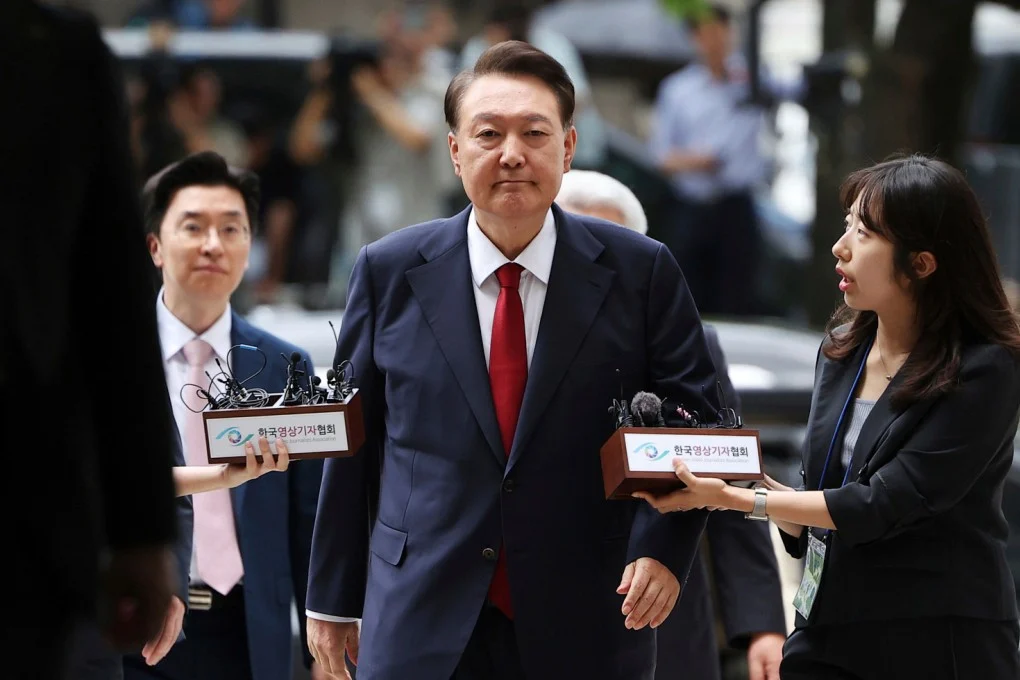
SEOUL — In a quiet, high-security courtroom that once saw the sentencing of military dictators, South Korea’s democratic resilience faced its ultimate test today.
On Thursday, February 19, 2026, the Seoul Central District Court sentenced former President Yoon Suk Yeol to life in prison. The verdict marks the dramatic end of a political saga that began with a desperate, middle-of-the-night declaration of martial law on December 3, 2024—a move that pushed one of Asia’s most vibrant democracies to the brink of collapse.
“The defendant directly and proactively planned an offense that resulted in enormous social costs,” Presiding Judge Jee Kui-youn declared to a televised national audience. “It is difficult to find any indication that the defendant has expressed remorse.”
The Verdict of Rebellion
The court found the 65-year-old former prosecutor guilty of leading an insurrection and subverting the constitutional order. Under South Korean law, the ringleader of a rebellion faces only two possible fates: death or life imprisonment.
While the special prosecutor had sought the death penalty—arguing Yoon showed “absolutely no remorse” for mobilizing troops to blockade the National Assembly—Judge Jee opted for life behind bars. The court cited the “lack of meticulous planning” and the fact that Yoon’s bungled power grab ultimately resulted in no loss of life as reasons for the slightly more “moderate” sentence.
The Fallout of the ‘Six-Hour Siege’:
- The Military Mandate: The court ruled that sending armed soldiers to the National Assembly to arrest political opponents was a clear act of insurrection.
- Co-Conspirators: Former Defense Minister Kim Yong-hyun was sentenced to 30 years for his role in planning the mobilization.
- The Inner Circle: Former Prime Minister Han Duck-soo and Interior Minister Lee Sang-min have already received 23-year and 7-year sentences, respectively, for their involvement.
A Nation Divided at the Gates
Outside the courthouse, the physical and political divisions of the country were on full display. Pro-Yoon protesters, many clutching “Not Guilty” signs, looked on in stunned silence as the verdict was read, with some collapsing in tears. Five hundred meters away, progressive groups erupted in cheers, though many expressed disappointment that the court spared Yoon the gallows.
Yoon himself remained stony-faced throughout the reading. Since his removal from office by the Constitutional Court in April 2025, he has consistently maintained that his decree was a “legal exercise of presidential power” aimed at stopping an opposition-controlled parliament from paralyzing the state.
The Shadow of History
For many South Koreans, the trial felt like a haunting echo of the past. Yoon was sentenced in Courtroom 417, the same room where former military strongmen Chun Doo-hwan and Roh Tae-woo were convicted for their roles in the 1979 coup and the 1980 Gwangju Massacre.
By convicting an elected leader of insurrection in the 21st century, South Korea’s judiciary has signaled that the “imperial presidency” is officially dead.
What Comes Next?
Current President Lee Jae-myung, who took office in June 2025 following the snap election, now leads a nation still reeling from the chaos. While Yoon’s legal team has vowed to “fight until the end” and is expected to appeal, the former president is unlikely to see the sun as a free man anytime soon.
He is already serving a separate five-year term for abuse of power, and he faces six additional criminal trials, including a treason charge related to drone incursions into North Korean airspace. In the “Year of the Fire Horse,” the gallop of justice in Seoul shows no signs of slowing down.