
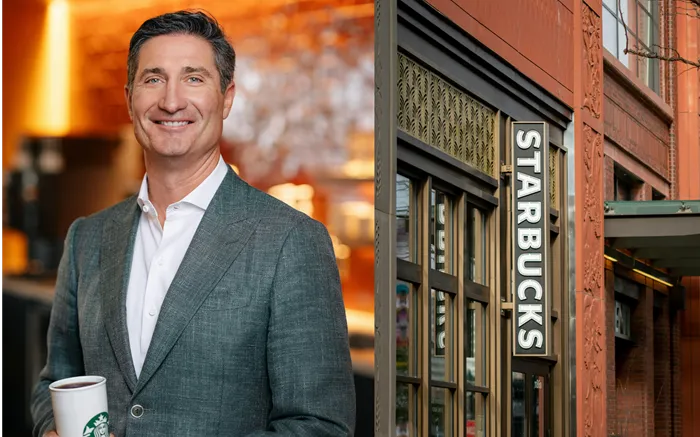
Starbucks Corp. is loosening the purse strings on its most controversial executive perk, mandating that Chief Executive Officer Brian Niccol fly exclusively via company jet for all travel—business and personal—while effectively handing him a blank check to do so.
In a regulatory filing released late Monday, the coffee giant disclosed that its board has eliminated a previous $250,000 annual cap on Niccol’s personal use of corporate aircraft. Under the revised agreement, the “super-commuter” CEO—who famously refused to relocate from Newport Beach, California, to the company’s Seattle headquarters—will no longer be required to reimburse the firm for personal flights.
The move transforms what was once a highly scrutinized allowance into a mandatory safety protocol, citing an increasingly volatile “threat landscape” for high-profile American executives.
A Security-First Mandate
The board’s decision followed a comprehensive security review conducted by a global risk management firm. The study cited “enhanced media attention” and the existence of “credible threat actors” targeting the CEO as the primary drivers for the policy shift.
By requiring Niccol to use the company’s Gulfstream G550 for every trip, Starbucks joins a growing list of U.S. corporations tightening executive protections following the fatal shooting of UnitedHealthcare CEO Brian Thompson in Manhattan late last year.
“This wasn’t a decision about luxury; it was a decision about the physical safety of our principal,” a Starbucks spokesperson said. “The board determined that the risks of commercial travel, even in first class, had become unacceptable given the current environment.”
The $31 Million Man
The jet policy update arrived alongside disclosures of Niccol’s compensation for fiscal 2025. While his total pay package of $31 million is a significant drop from the $95.8 million “mega-grant” he received upon signing in 2024, the underlying costs of maintaining his lifestyle remain astronomical.
The Niccol Security & Travel Ledger (Fiscal 2025):
- Total Security Costs: $1.1 million
- Private Jet Usage: Just under $1 million
- Temporary Housing: $370,000 (including tax-related costs)
- Commute Distance: ~1,000 miles (Newport Beach to Seattle)
While the $250,000 hard cap is gone, the board has replaced it with a quarterly review process by the chair of the Compensation Committee to maintain a semblance of oversight.
A Sustainability Paradox
The decision has reignited a fierce debate over corporate hypocrisy. For years, Starbucks has marketed itself as an environmental leader, pledging to halve its carbon footprint by 2030 and famously banning plastic straws. Critics argue that facilitating a CEO’s weekly 2,000-mile round-trip commute via a carbon-heavy private jet—now without even a nominal financial limit—shatters that credibility.
“You can’t ask customers to pay extra for oat milk to ‘save the planet’ while your CEO is burning thousands of gallons of jet fuel to avoid a three-hour commercial flight,” said one environmental advocate on social media.
The Turnaround Gamble
Investors, however, seem willing to overlook the optics as long as the “Niccol Magic” works. Since taking the helm from Laxman Narasimhan, Niccol has been tasked with fixing a slumping U.S. business plagued by slow service and high prices.
On Wednesday, the company reported its first quarter of U.S. sales growth in two years, driven by successful holiday promotions and the viral success of the “Bearista” cup. The stock jumped nearly 6% on the news, suggesting that for Wall Street, a million-dollar jet bill is a small price to pay for a returning customer base.
As Niccol prepares for an intensive investor day on Thursday, he remains the most expensive “commuter” in corporate history—a leader whose safety, and carbon footprint, are now officially part of the Starbucks brand.