
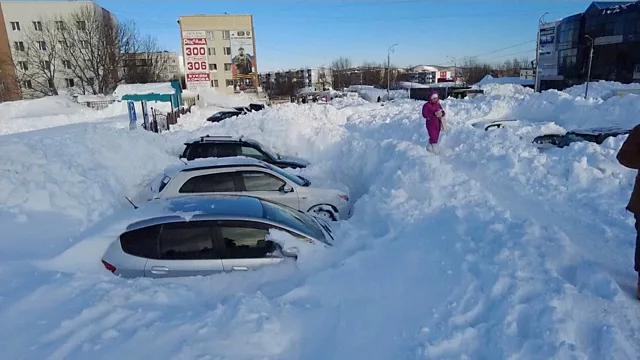
PETROPAVLOVSK-KAMCHATSKY — The Russian Far East is currently entombed in a “once-in-a-generation” winter emergency, as a relentless series of Pacific cyclones has buried entire neighborhoods under snowdrifts reaching as high as 5 meters (16.4 feet).
The Kamchatka Peninsula, already accustomed to brutal winters, has seen its infrastructure collapse under the sheer weight of the accumulation. In the regional capital of Petropavlovsk-Kamchatsky, snow cover has reached a historic 170 centimeters (5.6 feet) on level ground, with wind-whipped drifts swallowing cars, streetlights, and the first two floors of apartment buildings. Meteorologists report that this is the heaviest snowfall the region has witnessed in over 50 years, with some areas receiving 150% of their typical January precipitation in just the first two weeks of the year.
A City in a Tunnel
Daily life in the port city has been replaced by a struggle for survival and mobility. With traditional buses unable to navigate the “snow canyons” that were once streets, the government has deployed National Guard police vans and high-clearance military “shift-buses” to ferry essential workers.
The human impact has been surreal and, at times, tragic:
- Window Exits: Residents in several districts have been filmed leaping from second- and third-story windows into massive snowbanks after their front doors were completely sealed by “concrete-like” drifts.
- Hand-Dug Mazes: In place of sidewalks, a network of narrow, hand-carved tunnels now connects apartment entrances to the few cleared main arteries.
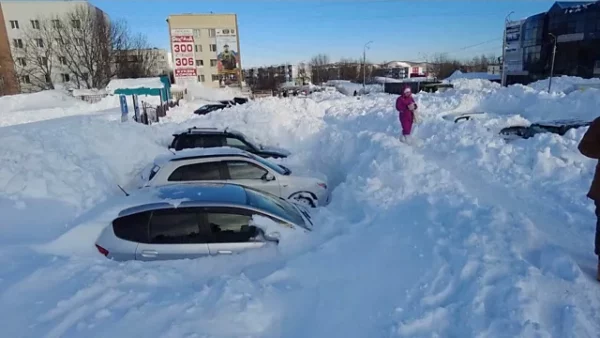
- The “Lost” Fleet: Thousands of cars have been “parked” in snowdrifts for weeks, their locations marked only by the occasional antenna poking through the white expanse.
State of Emergency and Fatalities
Governor Vladimir Solodov declared a municipal state of emergency after the crisis turned lethal. At least two residents—both elderly men—were killed when massive sheets of snow and ice dislodged from rooftops, burying them instantly.
The Emergency Situations Ministry has launched a series of “rescue-by-tunnel” operations, where crews use specialized equipment to dig through drifts to reach elderly residents trapped inside their homes without food or medicine.
“For the modern period of observation, these conditions are exceptionally rare,” said Vera Polyakova, head of Kamchatka’s Hydrometeorology Center. “We haven’t seen anything comparable since the early 1970s.”
The ‘Arctic Pulse’ Connection
The disaster is part of a broader “winter blast” sweeping across Asia. Scientists attribute the extreme accumulation to a weakened Arctic polar vortex, which allowed waves of frigid air to collide with warm, moisture-heavy Pacific cyclones over the Sea of Okhotsk.
While the storms began to recede on January 19, the recovery is expected to take weeks. Prices for private snow removal have surged to over 80,000 rubles ($900), and local stores continue to report “manual monitoring” of bread and milk supplies as delivery trucks struggle to reach isolated neighborhoods.
For now, the people of Kamchatka remain in a state of “strategic hibernation,” waiting for the heavy machinery—and the spring—to excavate them from the 2026 Snow Apocalypse.