
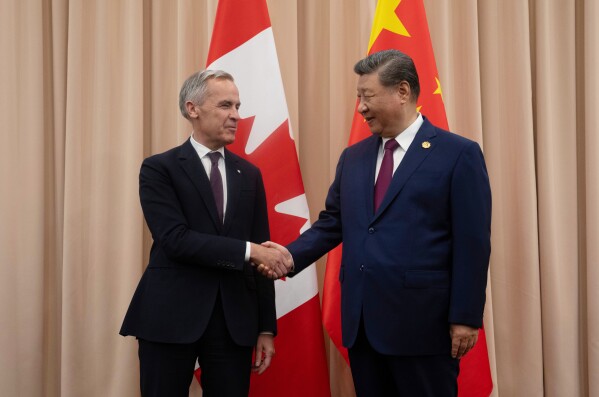
BEIJING — In a historic pivot that marks the end of nearly a decade of diplomatic frost, Canadian Prime Minister Mark Carney and Chinese President Xi Jinping announced a sweeping “agreement-in-principle” on Friday to dismantle billions of dollars in retaliatory tariffs.
The deal, struck in the Great Hall of the People on the final day of Carney’s four-day state visit, represents a fundamental recalibration of Canada’s foreign policy. By reaching a bilateral truce with Beijing, Carney has effectively broken ranks with the United States’ “Maximum Pressure” trade strategy, signaling Ottawa’s intent to build an independent economic path amid escalating tensions with the Trump administration.
“We have to understand the differences between Canada and other countries and focus our efforts where we are aligned,” Carney told reporters against the backdrop of a frozen lake in Beijing’s Great Hall park. “This is about building an economy that is resilient and less reliant on any single partner.”
The Grand Bargain: EVs for Canola
The centerpiece of the agreement is a sophisticated “tariff-for-quota” swap designed to resuscitate Canada’s battered agricultural sector while offering a lifeline to China’s beleaguered electric vehicle (EV) industry.
- Canada’s Concession: Ottawa will cut its 100 percent tariff on Chinese-made electric vehicles. In its place, a new quota system will allow up to 49,000 Chinese EVs into the Canadian market annually at a “Most Favoured Nation” rate of just 6.1 percent. This volume is expected to grow to 70,000 vehicles over the next five years.+2
- China’s Concession: In a massive win for Prairie farmers, Beijing will slash its combined tariff on Canadian canola seed from a staggering 85 percent down to 15 percent by March 1, 2026.
- Agricultural Relief: Anti-discrimination tariffs on Canadian lobster, crab, peas, and canola meal are also set to be suspended until at least the end of the year, unlocking an estimated $3 billion in export orders.
A New ‘Strategic Partnership’
The two leaders jointly announced a new “Canada-China Strategic Partnership” built on five pillars: energy, trade, public safety, multilateralism, and culture.
Beyond the immediate tariff relief, the summit produced eight memorandums of understanding (MOUs). Notably, the two nations decided to launch a Ministerial Energy Dialogue, focusing on both conventional oil and gas development and the scaling of clean technologies like batteries and solar storage. In a move aimed at restoring “people-to-people” ties, President Xi also pledged to introduce visa-free access for Canadians traveling to China.+2
The Greenland Shadow
The meeting was not solely focused on trade. Carney revealed that he and Xi found a “surprising alignment of views” regarding Arctic sovereignty—specifically in response to President Trump’s recent renewed threats toward Greenland.
Carney reiterated Canada’s stance that Greenland should determine its own future, a position that notably aligns with China’s interest in maintaining its status as a “near-Arctic state.” This shared rhetoric is likely to raise eyebrows in the White House, where the administration has viewed Canadian-Chinese cooperation in the North with increasing suspicion.
A Risky Gambit?
While the deal is being hailed as a “game-changer” by Canadian exporters who have seen their trade with China plummet by over 10 percent in the last year, it carries immense political risk.
By lowering EV tariffs, Carney is directly contradicting the trade barriers erected by both the Biden and Trump administrations to protect the North American auto supply chain. With the USMCA (United States-Mexico-Canada Agreement) up for renewal, the move could give Washington fresh ammunition to treat Canada as a “backdoor” for Chinese goods.
For Carney, however, the choice was clear. Facing a U.S. President who has suggested Canada could become “the 51st state,” the Prime Minister has chosen to diversify. “It is a historic and productive two days,” Carney said. “Together, we are bringing this relationship back toward where it should be.”