
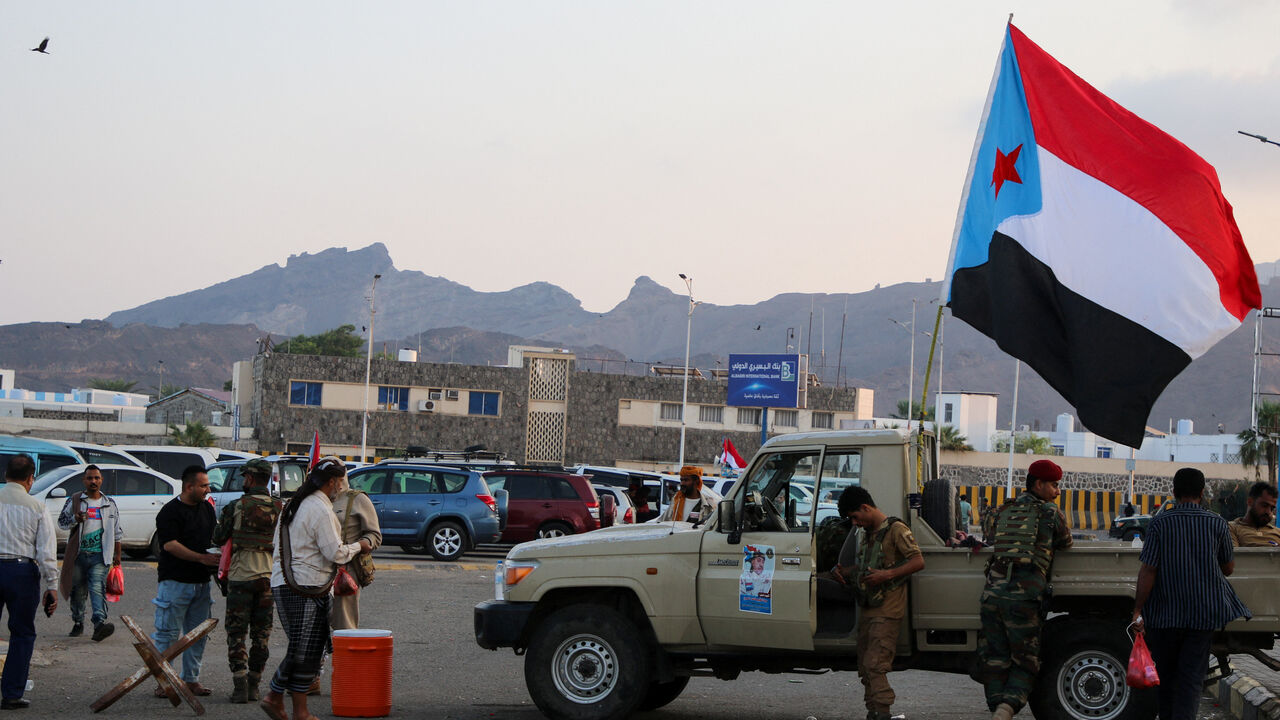
ADEN / RIYADH — The fragile alliance that once held southern Yemen together has shattered into a million pieces. In a rapid-fire sequence of political and military escalations on Wednesday, Aidarous al-Zubaidi, the powerful leader of the Southern Transitional Council (STC), was formally expelled from the government and accused of “high treason,” just as Saudi warplanes began pounding his strongholds.
The crisis marks a definitive rupture in the anti-Houthi coalition and signals a perilous new chapter in the Yemeni civil war—one that pits the Saudi-backed central government directly against the UAE-supported separatist movement in a fight for the future of the south.
The ‘No-Show’ at Riyadh
The fuse for Wednesday’s explosion was lit in the early hours at Aden International Airport. Al-Zubaidi was scheduled to board a Yemeni Airways flight to Riyadh for high-stakes “de-escalation” talks with Saudi officials.
- The Disappearance: While a 50-strong STC delegation boarded the plane, al-Zubaidi did not. Coalition spokesperson Major General Turki al-Maliki announced that the leader had instead “fled to an unknown location,” later identified by supporters as his home province of Al-Dhalea.
- The Intelligence: The Saudi-led coalition claimed it received “urgent intelligence” that during the flight delay, al-Zubaidi was instead mobilizing armored columns and distributing weapons to “armed gangs” within the interim capital of Aden.
- The Treason Charge: By morning, the Presidential Leadership Council (PLC)—the executive body of the Yemeni government—issued a blistering decree. It revoked al-Zubaidi’s membership and referred him to the public prosecutor for “high treason with the intent to undermine the independence of the Republic.”
Fire in Al-Dhalea: The Saudi Strikes
The political dismissal was immediately followed by kinetic force. At approximately 4:00 AM, the Royal Saudi Air Force launched a series of “pre-emptive” strikes across Al-Dhalea, al-Zubaidi’s home governorate and ancestral stronghold.
- The Targets: More than 15 airstrikes targeted military camps and suspected weapons depots in the Zubaid area.
- The Toll: Local hospital sources confirmed at least six people were killed, including civilians, and dozens were injured in the residential district where the strikes hit.
- The Resistance: Despite the bombardment, the STC remained defiant. “The President is on the ground in Aden, overseeing his duties,” said an STC official. “He will not be intimidated by an ultimatum of ‘come to Riyadh or we bomb you.'”
A Proxy War Unmasked
The “treason” row is the culmination of a month-long surge in which STC forces seized control of the resource-rich Hadramawt and Mahrah provinces—territories traditionally under Saudi influence.
“Saudi Arabia has chosen the path of treachery and betrayal. There will be immediate and long-term consequences for this unjustified escalation.” — Hani Bin Brek, Vice President of the STC
The conflict has effectively pitted the Gulf’s two most powerful nations against one another. While the United Arab Emirates announced a “voluntary withdrawal” of its forces last week under Saudi pressure, the “command and control” infrastructure it built for the STC remains the most potent military force in southern Yemen.
A Nation on the Brink
As of Wednesday night, the streets of Aden are a maze of checkpoints. The task of “securing” the city has been assigned to Abdulrahman Al-Mahrami, the STC vice-president who remains (for now) part of the PLC, in a desperate attempt by Riyadh to split the separatist leadership.
With al-Zubaidi now a “wanted man” and Saudi jets in the skies over the south, the dream of a unified anti-Houthi front is dead. The question now is whether the south will descend into a “war within a war,” or if al-Zubaidi’s “last stand” in Aden will force a radical redrawing of the map of the Arabian Peninsula.