
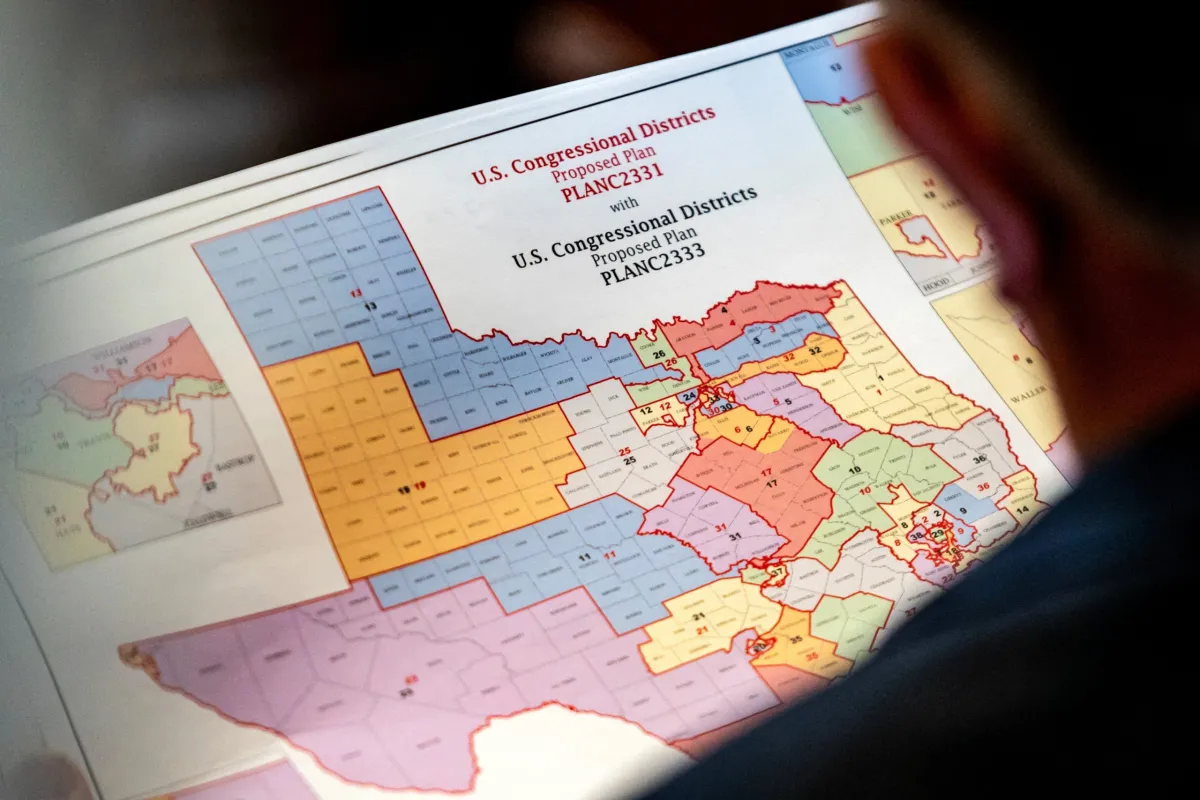
The U.S. Supreme Court delivered a decisive political victory to Texas Republicans and President Donald Trump on Thursday, ruling that the state may use its controversially redrawn congressional maps for the upcoming 2026 midterm elections.
In a brief, unsigned order, the high court temporarily paused a lower federal court ruling that had blocked the map, concluding that the district court had “improperly inserted itself into an active primary campaign” and noting that Texas is “likely to succeed” in its defense against the legal challenges. The decision effectively ensures the use of a map engineered to secure the GOP a significant advantage in the U.S. House.
The Map: More GOP Seats, Less Minority Influence
The congressional map, swiftly approved by the Texas Legislature and signed by Governor Greg Abbott in August 2025, was drawn as part of a national effort championed by President Trump to maximize Republican power in the House ahead of the midterms.
- The Projected Gain: Under the new lines, analysts project the Republican Party could gain as many as five additional seats in Texas, bringing their total control of the state’s 38 congressional districts from 25 to 30.
- The Conflict: A three-judge federal panel had previously blocked the map, finding that the state lawmakers had likely engaged in unlawful racial gerrymandering by dismantling districts previously designed to empower Black and Hispanic voters. This practice, unlike gerrymandering purely for partisan advantage (which the Supreme Court has generally allowed), is unconstitutional.
- The Supreme Court’s Rationale: The Supreme Court majority rejected the lower court’s urgency, citing the proximity of the December 8th candidate filing deadline for the March primaries. The majority effectively prioritized the stability of the election timeline over the immediate redress of the alleged racial bias.
Kagan’s Dissent: ‘Disrespects the Work’
The court’s three liberal justices—Justice Elena Kagan, Justice Sonia Sotomayor, and Justice Ketanji Brown Jackson—strenuously dissented, accusing the majority of disregarding serious evidence of racial discrimination.
“Today’s order… disrespects the work of a District Court that did everything one could ask to carry out its charge—that put aside every consideration except getting the issue before it right,” wrote Justice Kagan. She argued that the ruling effectively announced that Texas “may run next year’s elections with a map the District Court found to have violated all our oft-repeated strictures about the use of race in districting.”
Justice Samuel Alito, who initially handled the emergency appeal, had previously suggested that the evidence pointed to “pure and simple” partisan motivation, which the Supreme Court has historically ruled is permissible, thus rejecting the racial gerrymandering argument.
The Immediate Political Fallout
The ruling instantly upends the political landscape in Texas just before the filing deadline, restoring the calculus that had forced several Democratic incumbents into difficult primaries against fellow Democrats or into considering retirement.
The decision is seen as a key step in the Republican strategy to maintain control of the U.S. House, a fight that has already sparked mid-decade retaliatory redistricting efforts in other states, including California and North Carolina.
While the Supreme Court’s order is temporary, pausing the lower court ruling as the legal process plays out, its timing—just weeks before the start of the primary election cycle—makes it highly likely that this GOP-friendly map will be the one used throughout the crucial 2026 midterms.