
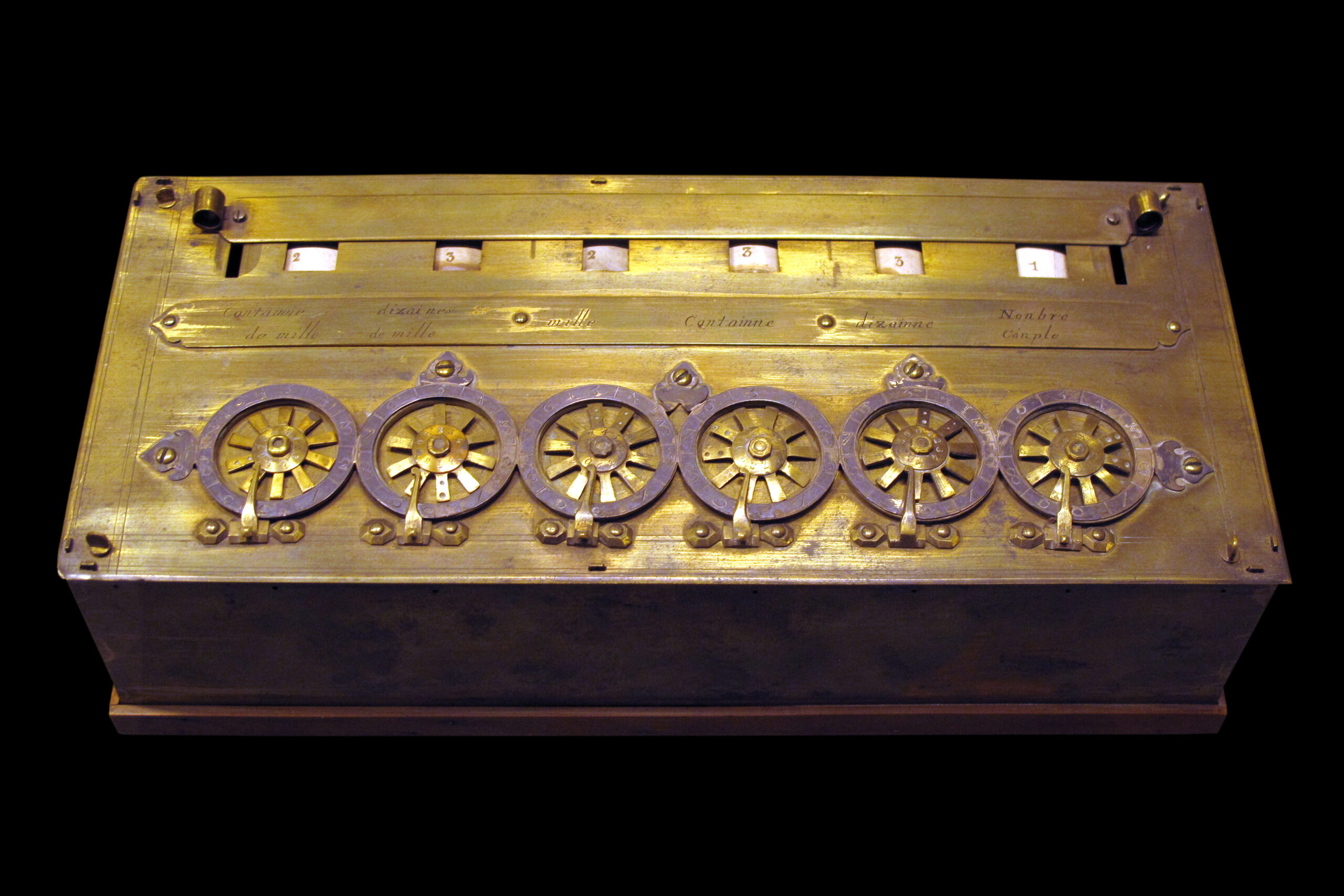
In a dramatic ruling just hours before bidding was set to begin, a Paris administrative court has ordered the suspension of the auction and export of one of the world’s most significant scientific artifacts: La Pascaline, the 17th-century mechanical calculating machine invented by philosopher and mathematician Blaise Pascal.
The stunning intervention by the court, which declared the 1642 device a likely “national treasure,” has scuttled the sale at Christie’s, where the ebony-inlaid machine was expected to fetch up to €3 million ($3.5 million). The decision represents a major victory for French scientists and cultural campaigners who fought to keep the dawn of modern computing within France’s public heritage.
The Battle for La Pascaline
Invented by Blaise Pascal at the age of just 19 to help his father, a tax collector, La Pascaline is recognized as the world’s first functioning mechanical calculator capable of addition and subtraction. Christie’s had billed the item as “the most important scientific instrument ever offered at auction,” describing it as “nothing less than the first attempt in history to substitute the work of a machine for that of the human mind.”
- The Private Hand: The specific model slated for auction is particularly rare, as it is one of only nine known to exist and the only one believed to remain in private hands. The others are housed in major European museums, including five in French public collections.
- The Legal Appeal: The court action was spurred by an urgent appeal from a group of eminent French scientists and academics, including Nobel laureates, who published an impassioned op-ed in Le Monde. They argued that the machine was a “shining symbol of French science and technology” and the very “origin of modern computing.”
- The Culture Ministry’s Blunder: The campaigners accused the Culture Ministry of committing an “astounding blunder” after it had previously issued an export certificate in May, which would have allowed any international buyer to take the priceless artifact out of the country.
Export Blockade and Final Ruling
The Paris court’s provisional ruling effectively suspends that export authorization, stating that given the machine’s “historical and scientific value,” it is highly likely to be classified as a “national treasure” under French law.
This classification is the highest level of cultural protection, immediately barring the object from leaving the country and triggering a 30-month period during which the French government and its partners have the exclusive right to raise the necessary funds to purchase the artifact for a public collection.
Christie’s confirmed that, at the instruction of the consignor, the sale—part of an auction of the late collector Léon Parcé’s library—has been suspended pending the final judgment from the court, a process that could take several months.
The dramatic intervention reaffirms France’s commitment to safeguarding key artifacts of its scientific and intellectual legacy, ensuring that the world’s first computing machine remains accessible for study and exhibition within the nation where it was born.