
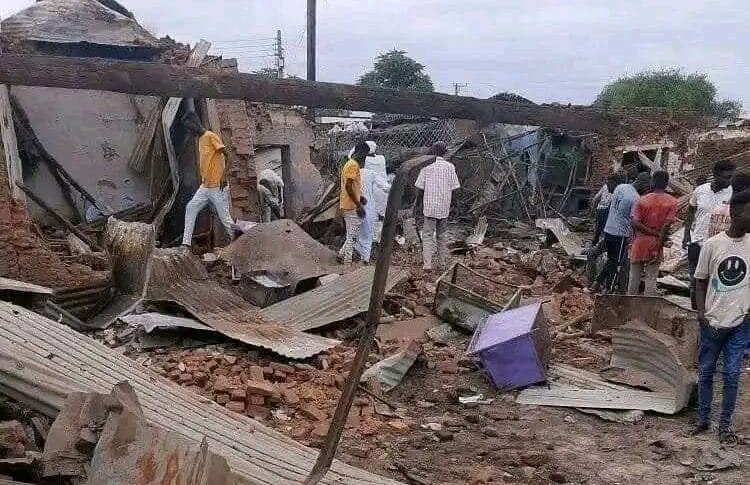
Wad Madani, Sudan — The nightmare that has consumed Sudan’s capital, Khartoum, has now metastasized into the heart of the country’s humanitarian refuge. With Wad Madani—the once-safe haven for hundreds of thousands fleeing the conflict—now under the firm grip of a powerful militia, tens of thousands of trapped civilians face an imminent and terrifying risk of ethnically motivated atrocities and mass summary executions.
The capture of the city by the Rapid Support Forces (RSF) has triggered a chilling wave of fear, reminiscent of the worst abuses documented in Darfur. Reports from international human rights monitors and the United Nations paint a grim picture: a new and deeply perilous phase in Sudan’s brutal civil war.
A Haven Turns to Hell
Wad Madani, the capital of Al Jazirah state and a vital agricultural and economic hub, had become the primary refuge for an estimated half a million people displaced by the fighting since April 2023. Its fall to the RSF late last year, followed by subsequent violent territorial shifts, has shattered any illusion of safety.
The recent military advances by the militia group and allied forces have been quickly followed by accounts of sickening brutality. The UN Human Rights Office has received multiple, alarming reports of summary executions targeting civilians, with strong indications of ethnic motivations. Eyewitness accounts and verified videos circulating among activists document a pattern of systemic violence:
- Targeted Retaliation: Militia fighters, acting in conjunction with or after a territorial gain, have been accused of targeting communities perceived as being affiliated with the rival Sudanese Armed Forces (SAF).
- Dehumanization and Execution: Footage reportedly filmed in and around the city shows men in uniform standing over bodies in civilian clothing. Victims are often dehumanized with slurs and denigrated as “traitors” before or after being executed.
- The Cycle of Reprisal: The violence has not been unilateral. Reports have also documented shocking reprisal attacks carried out by SAF-aligned forces and militias in areas they have subsequently recaptured, creating a deadly cycle of tit-for-tat massacres that devastate entire communities based on alleged or real ethnic and political identities.
The Humanitarian Catastrophe Deepens
The terror of the mass killings is compounded by a catastrophic humanitarian situation. The relentless fighting has caused massive displacement and a near-total collapse of essential services.
| Crisis Dimension | Impact on Wad Madani and Al Jazirah State |
| Displacement | Hundreds of thousands have fled the area, with over a million displaced nationally since the start of the conflict. |
| Healthcare | The main hospitals are severely damaged or non-functional; pharmacies have been looted, leading to a critical shortage of essential medicines. |
| Basic Services | Water and electricity remain largely unavailable. Unexploded ordnance (UXO) contamination poses a daily, lethal risk to returning civilians. |
| Livelihoods | Farmers missed planting seasons due to the fighting, threatening the region’s food supply and deepening the food crisis for the half of Sudan’s population already facing acute food insecurity. |
The UN High Commissioner for Human Rights, Volker Türk, has voiced deep alarm, stating that the situation for civilians is taking an “even more dangerous turn.” With the conflict spreading and the targeting of civilians based on identity becoming increasingly common, the brutal war risks accelerating into an unprecedented humanitarian catastrophe.
The message from aid agencies is clear: the violence must cease immediately. The impunity enjoyed by the perpetrators on all sides has emboldened them to commit crimes that constitute grave violations of international law. The world is witnessing the systematic destruction of a society, and for the thousands trapped in Wad Madani, the clock is ticking toward a potential horror show in the blinding global silence.