
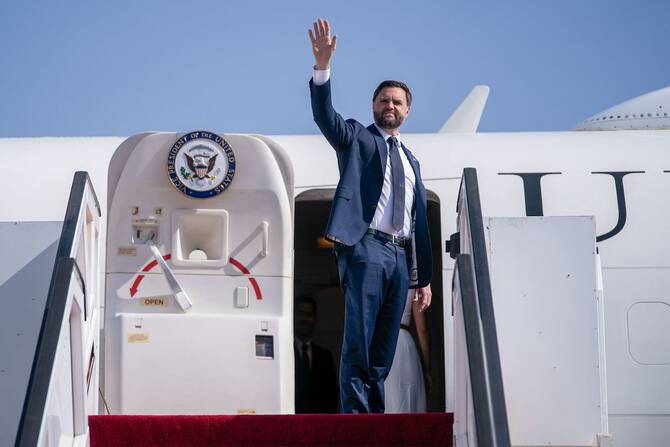
JERUSALEM — The Trump administration delivered an unusually sharp public reprimand to Israel’s parliament this week after lawmakers passed a preliminary, symbolic vote in favor of annexing the occupied West Bank. Vice President JD Vance declared the move an “insult” to U.S. policy, while Secretary of State Marco Rubio warned that such steps could jeopardize the fragile ceasefire deal in Gaza.
The condemnations, issued during a high-stakes diplomatic visit by top U.S. officials, underscore the intense pressure Washington is exerting on its closest ally to avoid any action that could destabilize the region or derail efforts to reconstruct Gaza.
Vance: “I Personally Take Some Insult To It”
Vice President Vance, wrapping up his two-day visit to Israel, minced no words regarding the Knesset’s vote, which was spearheaded by far-right, hardline lawmakers in what was widely seen as a deliberate attempt to embarrass Prime Minister Benjamin Netanyahu.
Speaking on the tarmac of Tel Aviv’s international airport, Vance stressed the administration’s red line. “The policy of the Trump administration is that the West Bank will not be annexed by Israel,” he stated firmly. “That will continue to be our policy. And if people want to take symbolic votes, they can do that, but we certainly weren’t happy about it.”
He went further, calling the measure a “very stupid political stunt” if its only intention was to sow discord. “I personally take some insult to it,” Vance added, highlighting the administration’s deep investment in securing the Gaza ceasefire and setting the groundwork for an international stabilization force.
Rubio Warns of Threat to Peace Deal
Vance’s strong language was immediately echoed by Secretary of State Marco Rubio, who arrived in Israel shortly after the Vice President’s departure to continue efforts to shore up the peace accord.
Rubio warned that the Knesset’s move was “potentially threatening to the peace deal” and could be “counterproductive” to the broader goal of stability. He stressed that while Israel is a democracy and lawmakers are free to take positions, the timing and substance of the vote risked undermining the entire diplomatic effort.
The U.S. opposition is driven by two critical concerns:
- Two-State Solution: Annexing the West Bank, a territory the Palestinians seek for a future independent state, would be widely viewed as eliminating any hope for a two-state solution, a policy goal supported by much of the international community.
- Arab Allies: The U.S. is currently seeking financial and logistical support from key Gulf Arab nations—including Saudi Arabia and the UAE—to fund and staff the post-war reconstruction and security force in Gaza. These nations have explicitly warned that Israeli annexation of the West Bank is a “red line,” making it nearly impossible for them to cooperate with a Washington-led initiative.
Netanyahu Orders Halt to Annexation Bills
The diplomatic pressure appears to have worked, at least for now. Following the vocal criticism from the White House, Prime Minister Netanyahu ordered a halt to the advancement of the controversial parliamentary bills.
Netanyahu’s office released a statement calling the Knesset’s vote a “deliberate political provocation” by the opposition. Although the move passed its preliminary reading with a narrow 25-24 margin, it would have required three additional votes to become law, a process that is now blocked by the Prime Minister.
The push for annexation reflects a deep internal rift within Israel’s ruling coalition, but the firm response from Washington makes clear that domestic politics will be quickly trumped by the administration’s resolve to maintain the fragile peace.