
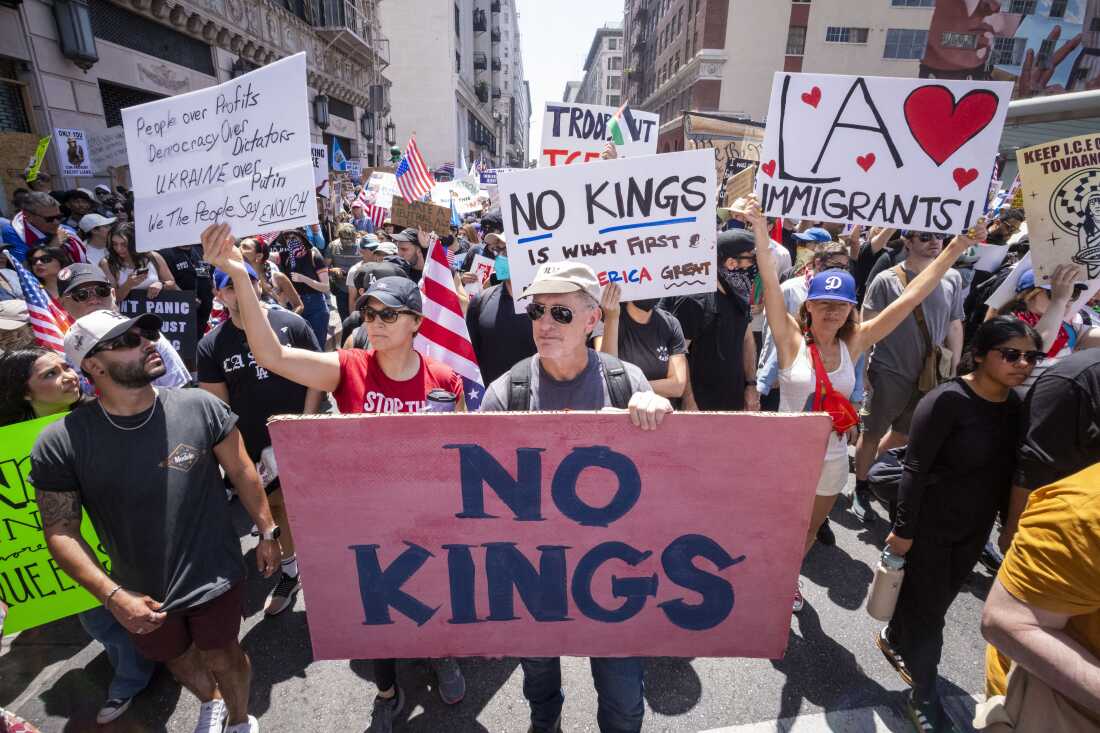
In a stunning, nationwide rebuke of the current administration, millions of Americans took to the streets on Saturday in a massive, coordinated demonstration dubbed the “No Kings” protests. From the National Mall to small-town squares in all 50 states, demonstrators—many clad in the signature yellow of the movement—mobilized across more than 2,700 locations to send an unequivocal message: the American republic has no sovereign ruler.
The outpouring of dissent, organized by a broad coalition of over 200 progressive groups including Indivisible and the ACLU, is one of the largest single-day protests in U.S. history. Organizers say the movement is a response to what they view as a pattern of “authoritarian power grabs” by the Trump administration since the start of its second term.
A Message Against Executive Overreach
The unifying slogan, “No Kings,” is a direct repudiation of what critics see as President Trump’s increasing consolidation of power, defiance of judicial constraints, and deployment of federal forces into American cities—moves that organizers argue are a violation of core democratic principles.
In a display of striking geographic diversity, the protests transcended traditional urban hubs. While massive crowds clogged Times Square in New York and filled Grant Park in Chicago, equally passionate demonstrations were held in rural communities from Bozeman, Montana, to East Glacier Ridge. This distributed model of resistance emphasizes that discontent with the administration is not confined to the coasts, but runs deep across the American heartland.
“This moment is not just about one man’s greed, corruption or contempt for the Constitution,” Senator Bernie Sanders told a thunderous crowd in Washington D.C., forcefully dismissing Republican criticism that the rallies were “Hate America” events. “Millions of us are here not because we hate America, but because we love America.”
Key Flashpoints and Concerns
The protests are fueled by a convergence of major policy concerns:
- Militarization of Cities: The administration’s move to federalize and deploy the National Guard and federal agents to combat crime and enforce immigration policy in Democratic-led cities has been a primary catalyst, with demonstrators denouncing the move as an attempt to suppress political dissent.
- Immigration Crackdown: Sweeping, aggressive immigration enforcement actions have galvanized human rights and civil liberties organizations, which participated heavily in the rallies.
- Democratic Norms: Underlying the specific policy grievances is a fundamental rejection of what protesters describe as an assault on the checks and balances of U.S. governance, citing the President’s public claims of absolute authority and his rhetoric against political opponents.
The use of the color yellow, chosen by organizers to signify unity and alignment with pro-democracy movements worldwide, created a vivid spectacle across the American landscape, an optical protest impossible for the administration to ignore.
In a muted response, the White House has largely dismissed the gatherings, with one spokeswoman stating simply, “Who cares?” However, Republican governors in states like Texas and Virginia preemptively mobilized National Guard troops, citing concerns over potential violence—a move quickly criticized by Democrats as a “dictatorial” escalation designed to intimidate peaceful assembly.
As the sun sets on this momentous day of defiance, the “No Kings” movement has successfully injected a powerful new strain of civic activism into the national conversation, firmly declaring that in America, the ultimate power still rests not with the executive, but with the mobilized will of its people.