
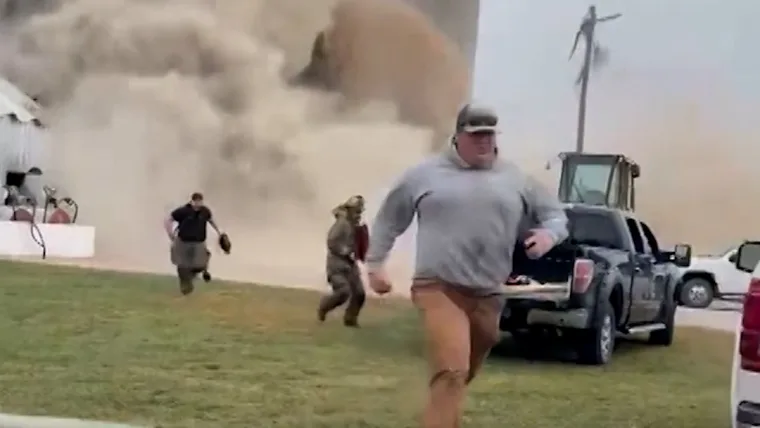
MARTINTON, Ill.—The heart of the American corn belt, Illinois, is routinely shaken by a disaster unique to its landscape: the catastrophic failure of its massive grain silos. These towering structures, which are essential to the state’s multi-billion-dollar agriculture industry, have become sites of sudden structural collapse and deadly worker entrapment, exposing a persistent crisis of aging infrastructure and hazardous operational practices.
A recent, dramatic example saw a concrete grain bin full of soybeans collapse in Martinton, Illinois, forcing emergency crews to flee moments before the structure snapped in half. This incident, which took out power lines and caused a widespread outage, is just one in a recurring pattern of failures across the state.
The Invisible Threats to a Visible Landmark
Grain silos and elevators, once heralded as the “skyscrapers” of the prairies, are subject to immense internal and external forces that can lead to sudden, total failure. Experts and investigators point to a lethal combination of factors:
1. Structural Aging and Corrosion
Many of Illinois’ grain storage facilities are decades old. Over time, exposure to moisture, chemicals, and extreme weather causes corrosion that thins the steel around seams and joints. Even minor foundation shifts or cracks can create catastrophic structural instability. As facilities strive to increase their handling capacity, older structures are often forced to handle heavier-than-designed loads, accelerating wear.
2. Uneven Loading and Unloading
The most critical stressor often comes from inside the silo itself. Grain behaves like a pressurized fluid; its weight is tremendous and must be distributed evenly.
- Asymmetric Pressure: Collapses often occur during the unloading process. If grain is drawn out from an off-center spout, or if blockages create an uneven distribution, the resulting asymmetrical pressure on the silo wall can cause it to buckle and tear.
- Over-Loading: Exceeding a bin’s peak load capacity, especially on older bins, puts dangerous stress on the roof and supporting infrastructure.
3. Dust Explosions and Fires
In facilities like the ethanol plant in Peoria, Illinois, where an explosion caused massive silo damage, the danger is combustible grain dust. Grain dust is highly flammable. A small spark from static electricity, a metal-on-metal strike, or faulty wiring can trigger a dust explosion that blows the silo apart, causing structural collapse and severe burns.
The Human Cost: A Matter of Life and Death
Beyond the material damage, silo failures are inextricably linked to the ongoing tragedy of grain entrapment. Illinois has seen a number of recent, high-profile entrapment cases, some resulting in fatalities.
These deaths are often the result of dangerously inadequate safety protocols:
- The “Quicksand” Effect: A worker standing on moving or flowing grain will be trapped within five seconds and completely covered in under thirty seconds. Moving grain creates a vortex with a compression force likened to an 80,000-pound truck on a person’s chest.
- The Bridge Collapse: Damp or clumped grain can form a “bridge” over an empty space created by unloading. When a worker walks onto this seemingly stable surface, the bridge can collapse instantly, burying them.
- OSHA Violations: Following a deadly 2010 incident in Mount Carroll where two teenagers were killed, federal investigations revealed that employers had willfully violated safety laws, including directing workers to “walk down the grain” and failing to shut down mechanical equipment—a stark reminder that many incidents are preventable.
Federal agencies have repeatedly cited Illinois grain operators for serious violations, pushing for greater adherence to the lockout/tagout standards and requiring safety harnesses.
For a state built on farming, the risks associated with the grain silo—a necessity of the trade—remain a harsh, persistent reality, demanding greater vigilance, maintenance, and adherence to safety protocols to protect both infrastructure and human lives.