
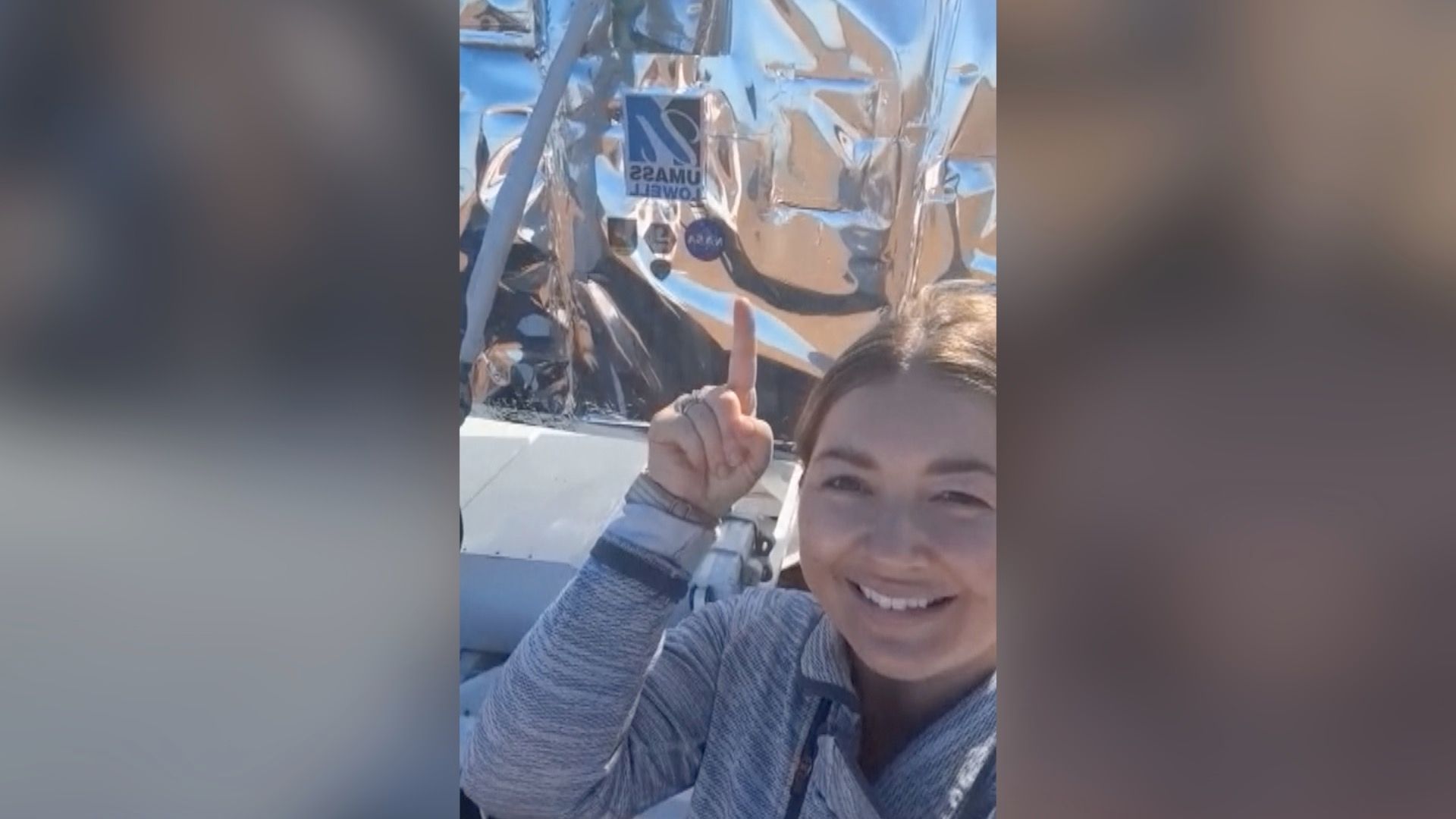
EDMONSON, Texas— The sky over rural West Texas usually offers little more than an endless horizon and the promise of rain. But last week, a local farmer was treated to a sight that was anything but ordinary: a bulky, car-sized piece of NASA scientific equipment, drifting down to Earth under a massive parachute before gently crash-landing in a neighbor’s wheat field.
Ann Walter, a resident of Edmonson, Texas, was the first to spot the unusual descent. “I didn’t know what to make of the bulky object slowly drifting across the sky,” Walter told reporters. Her initial surprise turned to awe when she realized the boxy, SUV-sized payload, emblazoned with NASA insignia, had touched down nearby, tethered to a parachute reportedly measuring 30 feet across.
The stunning find instantly transformed the quiet farmland into an unexpected staging ground for a space agency retrieval mission.
The Missing High-Altitude Balloon
A call to the Hale County Sheriff’s Office quickly confirmed that this was no stray debris, but a piece of lost government property. NASA was, indeed, looking for its missing equipment.
The wayward probe, which uses telescopes to gather information about distant stars, galaxies, and black holes, was part of an experiment launched by NASA’s Columbia Scientific Balloon Facility in Fort Sumner, New Mexico, approximately 140 miles to the west. High-altitude balloons carry these instruments to the edge of space—more than 20 miles into the atmosphere—to conduct research that benefits from the near-vacuum conditions.
Unfortunately for the mission team, the unpredictable Texas wind proved stronger than their trajectory models, pushing the massive package far off its intended recovery zone.
A Brush with Astrophysics
“It’s crazy, because when you’re standing on the ground and see something in the air, you don’t realize how big it is,” Walter said of the scientific vessel.
The unexpected arrival provided the Walter family with a rare, up-close encounter with high-level astrophysics research. Researchers from the balloon facility arrived shortly after the landing was reported, confirming the retrieval and thanking the family for their vigilance. The crew spent several hours moving the bulky experiment—which was thankfully unharmed and did not appear to damage the field—onto a trailer for its journey back to the lab.
“It’s kind of surreal that it happened to us and that I was part of it,” Walter reflected. “It was a very cool experience.”
While the incident is a unique local anecdote, it highlights the technical challenges faced by NASA’s scientific balloon program, where multi-ton payloads are launched to the cosmos’ doorstep before being brought back by simple parachutes, relying on the goodwill of local citizens when the winds of fate—and Texas—blow them off course. For one Texas family, the harvest season just became a lot more space age.