
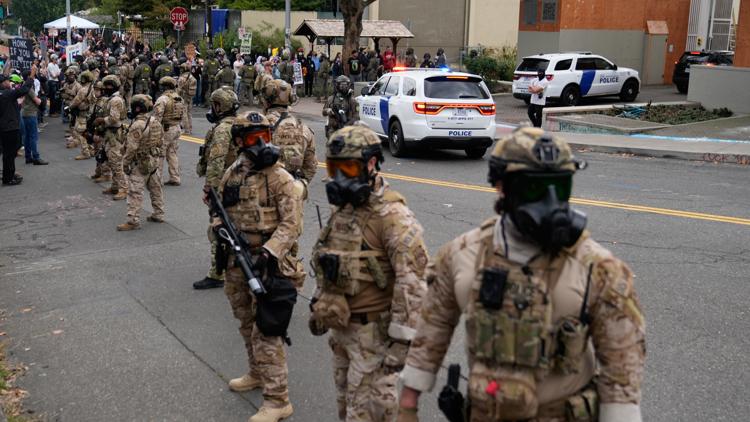
PORTLAND, ORE.—A federal judge late Sunday dealt a severe blow to the Trump administration’s aggressive troop mobilization strategy, issuing a temporary restraining order that blocks the deployment of hundreds of California National Guard troops to Portland, Oregon. U.S. District Judge Karin Immergut—a Trump appointee—issued the sweeping order, just hours after the administration attempted to circumvent her earlier ruling against the deployment of Oregon’s own National Guard.
The ruling dramatically caps a weekend of legal and political turmoil that saw the White House pivot immediately after its first court defeat, moving to reassign federalized National Guard members from California and even activating forces from Texas for duty in Portland and other cities.
A Direct Contradiction of the Court
The new restraining order came after the State of California joined Oregon’s original lawsuit, arguing that the administration was engaged in a “breathtaking abuse of the law and power.” Judge Immergut, presiding over a hastily called evening hearing, was openly critical of the government’s quick turn to out-of-state National Guard units.
“I am certainly troubled by now hearing that both California and Texas are being sent to Oregon, which does appear to be in direct contradiction of my order,” Immergut stated, grilling federal attorneys on the legal basis for the move.
The judge had initially ruled on Saturday, temporarily blocking the federalization of 200 members of the Oregon National Guard to protect the U.S. Immigration and Customs Enforcement (ICE) facility in Portland. That ruling determined that the president lacked the legal authority to deploy the troops, noting that the small, mostly dwindled protests at the facility did not constitute a “rebellion” or demonstrate an inability for existing federal law enforcement to execute laws. The president’s claims that Portland was “war-ravaged” were described by the judge as “simply untethered to the facts.”
In response, the Trump administration announced plans to send approximately 200 federalized California National Guard members, already under federal control from a previous deployment in Los Angeles, to Portland. Approximately 100 troops landed in Portland shortly after midnight on Sunday, according to court filings, before the judge issued her new order to stop any further deployment or relocation. The Pentagon also submitted a memo to the court detailing the activation of up to 400 Texas National Guard personnel for deployment to Portland and Chicago.

A Victory for State Sovereignty
Governors from both states swiftly celebrated the court’s intervention, framing it as a critical check on federal overreach.
California Governor Gavin Newsom described the decision as a victory for “American democracy itself.” “Donald Trump tried to turn our soldiers into instruments of his political will,” Newsom said in a statement. “Tonight the rule of law said ‘hell no.'”
Oregon Governor Tina Kotek echoed this sentiment, arguing that the President’s actions amounted to an attempt to “occupy and incite” cities that did not align with his politics. “Oregon is our home, not a military target,” Kotek stated, stressing there was “no need for military intervention.”
The lawsuit at the heart of the matter argues that the deployment violates the U.S. Constitution and the Posse Comitatus Act, which generally limits the use of the military for domestic law enforcement. The states contend that the deployment is unwarranted by conditions on the ground and interferes with state sovereignty.
Judge Immergut’s second ruling is even more expansive than her first, temporarily prohibiting the President from deploying any state’s federalized National Guard troops to Oregon. The temporary restraining order is set to remain in effect for two weeks, giving the states time to argue for a more permanent injunction, while the White House is expected to appeal the ruling.