
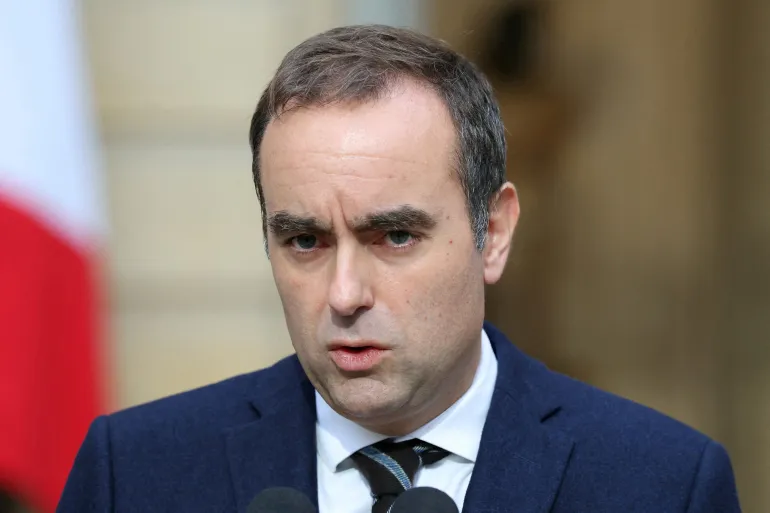
France’s political crisis has escalated dramatically after Prime Minister Sébastien Lecornu resigned on Monday, a mere 26 days after his appointment. His departure, which sets a record for the shortest premiership in the history of the Fifth Republic, came less than 24 hours after he unveiled a new cabinet that instantly triggered a firestorm of opposition, paralyzing the government before it could even hold its first official meeting.
President Emmanuel Macron, who is facing record-low approval ratings, was left reeling by the resignation of his fifth prime minister in just two years. The shock move underscores the deep-seated gridlock of a hung parliament and the mounting pressure on the French executive to tackle a spiralling public debt crisis.
The 14-Hour Government
Appointed on September 9th to replace the ousted François Bayrou, the former Defence Minister Lecornu, a close Macron loyalist, was tasked with forming a government capable of navigating the deeply fragmented National Assembly. He had spent 26 days—a record period of political limbo—in consultations, promising a “profound break” with the past to build a broad consensus.
However, the cabinet he presented late Sunday evening failed spectacularly to live up to that pledge. The lineup was largely a reshuffle of familiar faces, including the controversial return of former Finance Minister Bruno Le Maire, which instantly alienated both allies and foes.
Opposition from the conservative Les Républicains (LR) proved to be the immediate trigger for the collapse. The party, whose support was critical for any chance of a stable majority, lashed out at the “continuity” cabinet, arguing it betrayed the promised change. Faced with the immediate threat of a no-confidence vote from a united opposition—from the far-right National Rally (RN) to the hard-left France Unbowed—Lecornu chose to quit before he could be censured.
Speaking outside the Hôtel Matignon, the Prime Minister’s residence, Lecornu pointedly blamed “partisan appetites” and the “egos” of political factions unwilling to compromise. “One cannot be prime minister when the conditions are not met,” he stated, lamenting that every party insisted the other fully adopt its program.
Macron’s Diminishing Options
Lecornu’s resignation further highlights the instability rooted in Macron’s 2024 snap election gamble, which left the parliament split into three nearly equal, mutually hostile blocs. The political uncertainty immediately rattled financial markets, with the Paris CAC 40 stock index dropping sharply and the Euro sliding, as investors worried about France’s ability to address its severe budget deficit, the largest in the eurozone.
The central issue remains the government’s mandate to pass an austerity budget—a challenge that defeated Lecornu’s two immediate predecessors, Bayrou and Michel Barnier. France’s public debt stands at a worrying 114% of GDP, and international rating agencies are watching closely.
The pressure on President Macron is now intense. The far-right and the hard-left have seized on the chaos, with RN leader Marine Le Pen publicly calling on the President to either dissolve the National Assembly for a new legislative election or resign.
For now, the Elysée Palace is attempting a last-ditch effort for stability. Hours after his resignation, Macron requested that Lecornu stay on for a 48-hour period to conduct “final negotiations” to define a “platform for action and stability.” Should this eleventh-hour effort fail by Wednesday evening, Macron faces two unenviable choices: appoint a sixth Prime Minister with no clear path to a majority, or call another snap election, a gamble which polls suggest could hand the reins of power to the far-right.
As a caretaker government manages day-to-day affairs, France—the European Union’s second-largest economy—is facing an unprecedented constitutional challenge. The record-short tenure of Sébastien Lecornu has not just ended a premiership; it has exposed a fundamental fracture in French governance that threatens to derail critical reforms and international standing.