
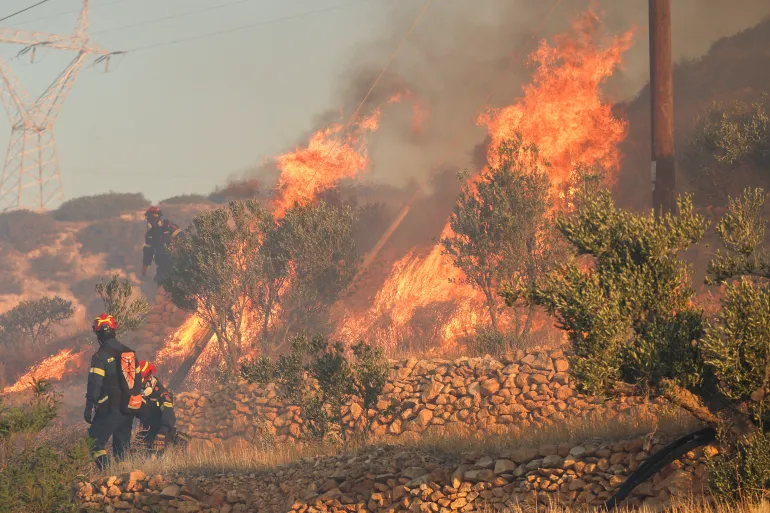
Greece is once again engulfed in a summer of fiery devastation, with major wildfires tearing through its parched landscapes, forcing mass evacuations and threatening homes on the outskirts of the capital, Athens. As a scorching heatwave persists, fanning the flames with strong winds, emergency services are battling a multi-front crisis that highlights the escalating impact of climate change on this Mediterranean nation.
The most critical front emerged on Saturday in Kryoneri, a northern suburb just 20 kilometers (12.5 miles) northeast of Athens. Residents received urgent SMS messages to evacuate as flames consumed parts of the area, with Greek media showing houses already ablaze. Fire Service spokesman Vassilis Vathrakoyannis warned, “The real difficulties are ahead of us,” confirming that Greece has requested six firefighting planes from the European Union’s Civil Protection Mechanism to bolster its overstretched resources.
On the ground, 145 firefighters, supported by 44 fire engines, 10 planes, and seven helicopters, are desperately trying to contain the Kryoneri blaze, whose origin remains unknown. At least five residents, primarily elderly individuals suffering from respiratory problems due to the thick smoke, have required medical attention.
The fire near Athens is just one of many raging across the country. Greece’s fire service is simultaneously battling three other major infernos: on the large islands of Crete in the south, Evia north of Athens, and Kythera northwest of Crete. In total, a staggering 52 wildfires broke out across Greece in the past 24 hours alone, stretching firefighters to their limits. Over 335 firefighters, 19 planes, and 13 helicopters are deployed nationwide, but aerial operations are severely restricted to daylight hours.
A Recurring Nightmare Driven by Climate Change
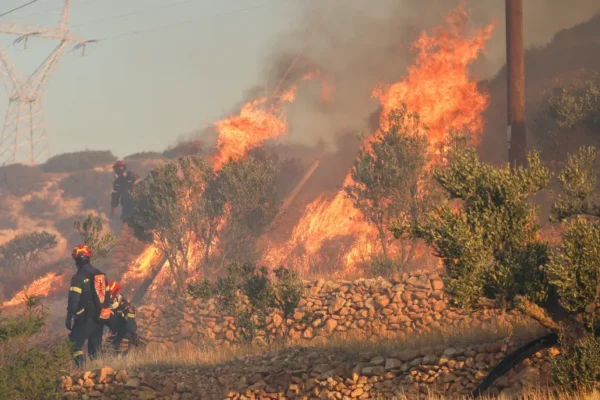
Wildfires have become a tragic, annual occurrence in Greece, particularly during its long, dry summers. However, recent years have seen an alarming increase in their frequency, intensity, and destructiveness. Scientists and authorities are unequivocal in linking this escalating crisis to climate change.
Temperatures in Greece have been soaring, with many areas experiencing a week-long heatwave that saw mercury levels surpass 38 degrees Celsius (100 degrees Fahrenheit), and in some regions, even exceeding 45 degrees Celsius (113 degrees Fahrenheit). These prolonged heatwaves, combined with drought conditions and strong winds, create a tinderbox environment where fires ignite easily and spread with terrifying speed.
The World Health Organization (WHO) has warned that “with climate change leading to warmer temperatures and drier conditions and the increasing urbanization of rural areas, the fire season is starting earlier and ending later.” They emphasize that “wildfire events are getting more extreme in terms of acres burned, duration and intensity.”
Beyond natural factors, human activity also plays a significant role. While some fires are attributed to lightning, a considerable number are caused by human negligence, such as improperly extinguished campfires, discarded cigarettes, or uncontrolled debris burning. Arson is also a contributing factor in some cases. Rapid urbanization encroaching on wildland areas further increases the risk, placing more ignition sources near combustible vegetation.
As the sun sets, casting an orange glow over a smoke-filled sky, the immediate priority remains protecting lives and containing the blazes. Authorities have issued extreme fire risk warnings for several regions, placing them under a red Category 5 alert – the highest on the national scale. For the thousands of evacuated residents, the future remains uncertain, with many returning to find their homes and livelihoods consumed by the relentless flames.
Greece’s ongoing battle against these infernos serves as a stark and urgent reminder of the devastating reality of a warming planet, where extreme weather events are becoming the terrifying new normal.