
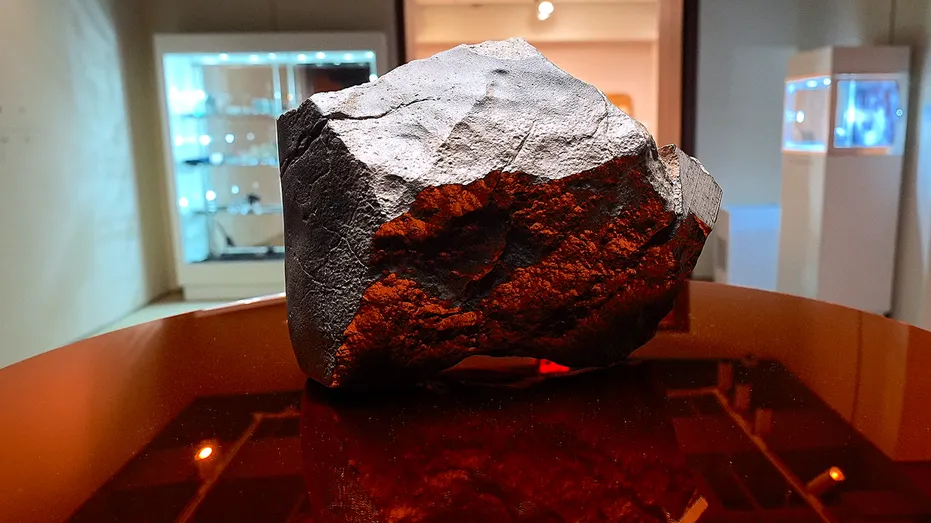
A piece of the Red Planet, a testament to cosmic violence and interplanetary journeys, has found a new home on Earth, fetching a staggering $5.3 million at a Sotheby’s auction in New York. The 54-pound (25-kilogram) meteorite, designated NWA 16788, is the largest known piece of Mars ever discovered on our planet, captivating collectors and scientists alike with its immense size and extraterrestrial origins.
The colossal rock, roughly 70% larger than the next largest known Martian meteorite, was discovered in November 2023 by a meteorite hunter in the Sahara Desert in Niger. Scientists believe it was violently blasted off the surface of Mars by a massive asteroid strike, embarking on an epic 140-million-mile (225-million-kilometer) journey through space before eventually crashing to Earth.
“This Martian meteorite is the largest piece of Mars we have ever found by a long shot,” stated Cassandra Hatton, Vice Chairman for Science and Natural History at Sotheby’s, before the sale. “It’s more than double the size of what we previously thought was the largest piece of Mars.”
The auction, part of Sotheby’s “Geek Week 2025,” saw the unique specimen exceed its pre-sale estimate of $2 million to $4 million. The final bid for the red, brown, and gray meteorite was $4.3 million, with various fees and costs pushing the official sale price to approximately $5.3 million. The identity of the fortunate new owner was not immediately disclosed.
What makes NWA 16788 so exceptional is its rarity and scientific significance. Of the approximately 77,000 meteorites identified on Earth, only about 400 are confirmed to have originated from Mars. Most of these Martian fragments are no larger than pebbles, making the 15-inch by 11-inch by 6-inch (375 millimeters by 279 millimeters by 152 millimeters) NWA 16788 an extraordinarily valuable specimen. It represents nearly 7% of all known Martian material currently on our planet.
Confirming its Martian heritage involved rigorous scientific testing. A specialized lab examined a small piece of the meteorite, comparing its distinct chemical composition with data collected by NASA’s Viking space probe, which landed on Mars in 1976. The analysis revealed it to be an “olivine-microgabbroic shergottite,” a type of Martian rock formed from the slow cooling of Martian magma. Its glassy surface is likely a result of the intense heat it endured during its fiery descent through Earth’s atmosphere.
The sale of NWA 16788 highlights a thriving market for rare geological and archaeological objects, where the allure of space rocks continues to command astronomical prices. For scientists, such meteorites provide invaluable opportunities to study Mars firsthand, offering clues to the Red Planet’s geological history and the potential for past or present life, without the immense cost and complexity of a space mission. This latest sale ensures that a significant piece of Mars will continue to inspire wonder and scientific inquiry, albeit now in private hands.